

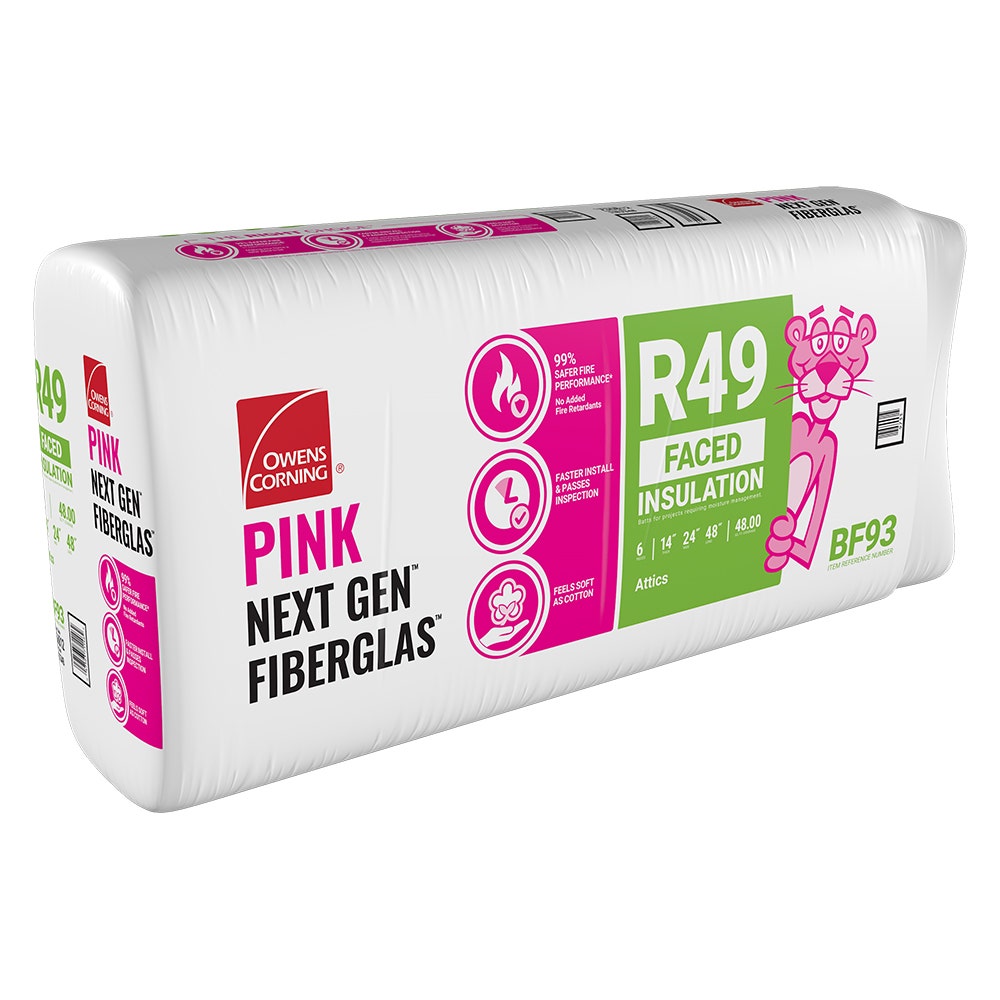
24 in. width for one-piece coverage on 24 in. o.c. ceilings
Key features
Kraft facing supports Class I vapor-retarder detailing when oriented per code
PINK Next Gen handling with improved recovery after compression packaging
Technical specifications
| R-Value | 49.0 |
|---|---|
| Thickness | 14.0 in |
| Width | 24.0 in |
| Length | 48.0 in |
| Coverage | 48.0 sq ft/pack |
| Material | Fiberglass (PINK Next Gen) with kraft vapor-retarder facing |
| Fire rating | ASTM C665 Type I; glass fibers ASTM E136 noncombustible when unfaced. Kraft facing is combustible—follow OC guidance for ICC construction types and rated assemblies. |
| Sound rating | Thick cavity fill improves typical ceiling acoustics versus bare joists; final results depend on assembly. |
| Density | Light-density flexible batt per ASTM C665 manufacturer listings; see TDS for product-specific values. |
| Thermal conductivity | Labeled R-49 at stated thickness; see manufacturer TDS (ASTM C518) for tested conductivity. |
| Framing width | 24 in. width for 24 in. on-center joist or truss bottom chord spacing |
| Construction type | Wood-frame and light-gauge metal-frame cavity construction |
| Application area | Attics, ceilings, and framed cavities where kraft-faced R-49 batts are specified per code and drawings |
Product details
About 48 square feet per package (IDI-listed coverage). Primary use: attic floors, flat ceilings, and deep framed cavities on 24 in. on-center modules where the energy package specifies kraft-faced R-49 batts and a single 24 in. wide piece is preferred across the bay.
BF93 pairs the same high-R thickness as other R-49 batts in this line with factory kraft that acts as a coordinated vapor-retarder layer when installed on the appropriate side of the assembly per IECC and your hygrothermal plan. That facing is also combustible and cannot be left exposed—detail it behind approved finishes and protect from ignition sources per Owens Corning literature.
Field execution still demands vented-roof airspace where required, continuous air sealing at the sheathing or interior control plane, and honest thickness at eaves and mechanical chases.
Manufactured to ASTM C665. Glass fibers are noncombustible per ASTM E136 when unfaced; kraft-facing burns—follow OC guidance for ICC construction types III, IV, and V for faced products. GREENGUARD certification with formaldehyde-free validation and a UL Environment EPD support typical submittals. Use the linked installation guide and TDS for authoritative values.
Kraft-faced high-R attic batts integrate a Class I vapor-retarder layer when installed on the correct side of the assembly for your climate package—treat facing orientation as a code item, not a crew preference.
Facing is combustible: maintain required thermal/ignition protection and never leave kraft exposed as a finished surface in living spaces or garages unless a specific assembly allows it.
PINK Next Gen lines are commonly documented with ASTM C665 Type I language plus GREENGUARD-backed low-formaldehyde validation on distributor collateral; the kraft facing still requires rated gypsum or another approved thermal barrier per assembly—not the facing alone.
Submittal discipline: keep the distributor-listed dimensions (14.0 in. × 24.0 in. × 48.0 in.) and about 48.0 square feet per package attached to the same SKU on purchase orders, delivery tickets, and photos for QA. Authoritative tested language and code-oriented statements belong in the current manufacturer technical data sheet at https://www.idi-insulation.com/media/pdfresources/1000963_data_sheet.pdf.
Documents & certifications
Technical data sheet
Manufacturer-tested R-value, coverage, fire notes, and handling—use for submittals, RFIs, and field QA.
Download PDF (opens in new tab)Certifications & compliance
GREENGUARD (formaldehyde-free validated), UL Environment EPD, California Title 24 Article 3 insulating materials
Frequently asked questions
Which way does the kraft face go?
Which way does the kraft face go?
Facing direction is a climate and assembly decision under IECC and local amendments—often toward the warm-in-winter side in heating-dominated climates, but mixed and humid cooling climates differ. Follow the approved drawings and Owens Corning installation literature.
BF93 versus unfaced BU92 at the same module?
BF93 versus unfaced BU92 at the same module?
BU92 is unfaced for designer-placed vapor control. BF93 adds kraft facing for projects that want the factory vapor-retarder layer integrated with the batt.
Can kraft-facing be left exposed in an attic?
Can kraft-facing be left exposed in an attic?
No. Kraft burns and is not a finished surface. Provide the required thermal/ignition barrier and interior finish per code.
How many bags for my attic?
How many bags for my attic?
Divide net insulated attic floor area by 48 square feet per bag and add waste for hips, drops, and mechanical chases.