

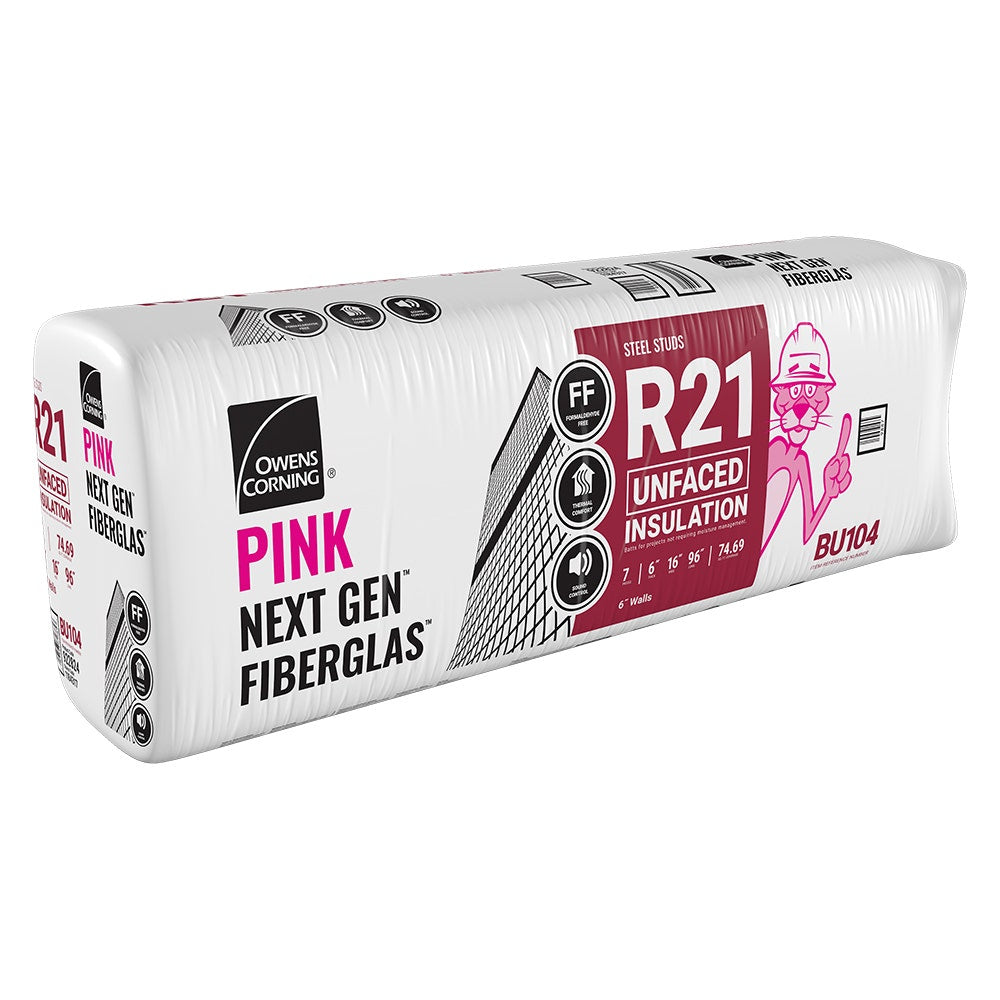
16 in. width for 16 in. o.c. nominal 2×6 stud bays
Key features
96 in. length for eight-foot wall production
Unfaced format for coordinated vapor-control and foam strategies
Technical specifications
| R-Value | 21.0 |
|---|---|
| Thickness | 5.5 in |
| Width | 16.0 in |
| Length | 96.0 in |
| Coverage | 74.67 sq ft/pack |
| Material | Fiberglass (PINK Next Gen), unfaced |
| Fire rating | ASTM C665; unfaced glass fibers classified noncombustible per ASTM E136 in manufacturer documentation. Unfaced PINK Next Gen acceptable ICC types I–V per OC literature. |
| Sound rating | Cavity-fill fiberglass improves typical wall STC versus an empty cavity; final acoustic performance is assembly-dependent. |
| Density | Light-density flexible batt per ASTM C665 manufacturer listings; see TDS for product-specific values. |
| Thermal conductivity | Nominal R-21 at full labeled thickness; see manufacturer TDS (ASTM C518) for tested conductivity. |
| Framing width | 16 in. width for 16 in. on-center stud spacing in nominal 2×6 walls |
| Construction type | Wood-frame and light-gauge metal-frame cavity construction |
| Application area | Exterior/interior walls, floors, and roof/ceilings; interior side of basement and unvented crawlspace walls per code |
Product details
About 74.67 square feet per package (IDI-listed coverage). Primary use: nominal 2×6 exterior or partition walls on 16 in. on-center framing where the project calls for unfaced R-21 batts and eight-foot material logistics.
BU104 packages Owens Corning PINK Next Gen fiberglass as a 16 in. wide batt at 96 in. length. Distributor technical tables list 5.5 in. labeled thickness for this R-21 SKU—the same glass depth family used elsewhere in the catalog for standard 2×6 R-21 batts—while consumer-facing titles sometimes round to six-inch nominal stud depth. Always bid using the labeled thickness and square feet per bag from the master-pack label, not a generic assumption from another width or facing.
Unfacing is deliberate: kraft-facing orientation mistakes are a common inspection failure mode in mixed climates, and many assemblies now pair cavity batts with exterior foam or smart vapor retarders on the interior. Unfaced batts cooperate with those strategies while still demanding meticulous air sealing at the sheathing plane, rim, windows, and penetrations. Split batts around outlets and pipes so you preserve full labeled thickness instead of packing wads that silently delete R-value.
Manufacturing complies with ASTM C665; unfaced glass fiber is classified noncombustible per ASTM E136 in manufacturer documentation, and unfaced PINK Next Gen is listed for ICC construction types I through V when installed per OC guidance. GREENGUARD certification with formaldehyde-free validation and a UL Environment EPD align with typical residential and multifamily submittals. Download the linked data sheet for authoritative tested values before inspection.
Nominal “2×6” marketing language often collides with labeled 5.5 in. glass depth on R-21 SKUs; estimators should bid thickness and coverage from the master pack, not from stud nicknames alone.
Mixed assemblies with exterior foam or smart membranes are increasingly common—unfaced cavity batts cooperate with those strategies when air sealing at rim, penetrations, and sheathing transitions is treated as a first-class detail.
Submittal discipline: keep the distributor-listed dimensions (5.5 in. × 16.0 in. × 96.0 in.) and about 74.67 square feet per package attached to the same SKU on purchase orders, delivery tickets, and photos for QA. Authoritative tested language and code-oriented statements belong in the current manufacturer technical data sheet at https://www.idi-insulation.com/media/pdfresources/1005618_data_sheet.pdf.
Documents & certifications
Technical data sheet
Manufacturer-tested R-value, coverage, fire notes, and handling—use for submittals, RFIs, and field QA.
Download PDF (opens in new tab)Certifications & compliance
GREENGUARD (formaldehyde-free validated), UL Environment EPD, California Title 24 Article 3 insulating materials
Frequently asked questions
Why does the title say 6 in. if the data sheet lists 5.5 in.?
Why does the title say 6 in. if the data sheet lists 5.5 in.?
Nominal 2×6 framing is six inches on centerline, but Owens Corning publishes R-21 batt thickness as 5.5 in. labeled glass depth for many SKUs. Always use the distributor TDS and bag stamp for thickness, not colloquial stud nicknames.
BU104 versus kraft-faced BF109 at the same module?
BU104 versus kraft-faced BF109 at the same module?
BF109 includes kraft facing for Class I vapor-retarder detailing when your climate package allows it. BU104 is unfaced—choose it when vapor control lives in another layer or when the specifier bans factory kraft in that assembly.
Can I double BU104 in one 5.5 in. cavity?
Can I double BU104 in one 5.5 in. cavity?
No. Over-packing fiberglass collapses effective R-value and can create compliance issues. If you need higher R-value, redesign cavity depth, add continuous insulation, or pick a different insulation system.
How many bags for my wall square footage?
How many bags for my wall square footage?
Divide net insulated wall area by about 74.67 square feet per bag and add a waste factor for openings, corners, and repack scrap—five to ten percent is a common starting point unless drawings say otherwise.