

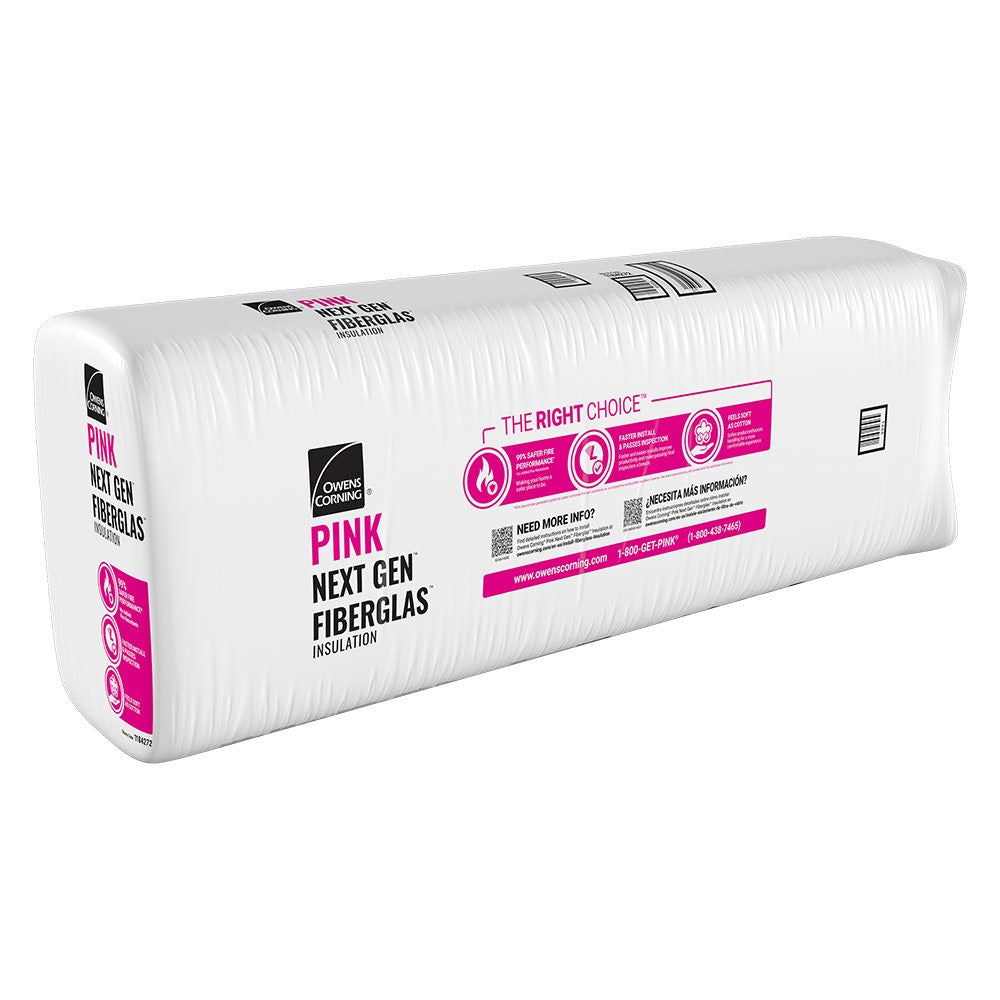
R-23-class performance in nominal 2x6 depth for stricter prescriptive or modeled wall U-factors
Key features
Smaller sq ft per bag than R-20 2x6 batts—always re-estimate quantities, not copy-paste BU50 counts
Unfaced + Next Gen fibers for coordinated vapor/air strategies and stiff cavity fill
Technical specifications
| R-Value | 23.0 |
|---|---|
| Thickness | 5.5 in |
| Width | 15.0 in |
| Length | 93.0 in |
| Coverage | 48.44 sq ft/pack |
| Material | Fiberglass (Owens Corning PINK Next Gen™ Fiberglas®, unfaced) |
| Fire rating | ASTM C665 Type I; glass (unfaced) classified noncombustible per ASTM E136. Coordinate rated assemblies with your AHJ when combining with facings, membranes, or foam. |
| Sound rating | Unfaced cavity-fill fiberglass improves typical assembly acoustics versus an empty cavity; field STC depends on framing, openings, and flanking paths. |
| Density | R-23 preformed high-R 2x6 batt; supplier part 924191 per IDI / Owens Corning listings |
| Thermal conductivity | Nominal R-value at full labeled thickness; see manufacturer TDS for tested thermal values. |
| Framing width | 15 in. width for nominal 16 in. on-center 2×6 high-R wall framing |
| Construction type | Wood-frame and light-gauge metal-frame cavity construction |
| Application area | High-performance 2×6 exterior walls on 16 in. o.c.; other cavities per engineered spec accepting 5.5x15x93 unfaced batts |
Product details
BU106 is the aggressive 2×6 cavity option: labeled R-23 in the same 5.5 in. depth class as R-20 batts, which means higher fiber density and a smaller roughly 48.44 square feet per package footprint (IDI listing)—purchasing teams must not substitute counts from BU50 spreadsheets or you will short the job. The 15 × 93 in. geometry still targets 16 in. on-center stud production with Next Gen handling characteristics crews expect.
Unfaced format keeps vapor and air barrier sequencing where the enclosure engineer wants it—critical when this wall type backs conditioned space against brick, rainscreen claddings, or exterior continuous insulation. Compliance documentation includes ASTM C665 manufacturing, ASTM E136 noncombustibility for unfaced glass, Title 24 Article 3 language, GREENGUARD validation, and EPD references.
Installation caveats are magnified with dense batts: do not double-compress at boxes, maintain full loft at intersecting partitions, and document thickness for QA when projects chase aggressive blower-door targets.
Documents & certifications
Technical data sheet
Manufacturer-tested R-value, coverage, fire notes, and handling—use for submittals, RFIs, and field QA.
Download PDF (opens in new tab)Certifications & compliance
GREENGUARD Certified (formaldehyde-free validated), UL Environment EPD, California Title 24 Article 3 insulating materials, ENERGY STAR® certified per manufacturer listings
Frequently asked questions
Why pick a 5.5 in. thick R-20 or R-23 batt instead of compressing R-30?
Why pick a 5.5 in. thick R-20 or R-23 batt instead of compressing R-30?
Compressing insulation lowers effective R-value. Preformed 2x6-depth batts preserve labeled loft for predictable energy and condensation margins.
Do unfaced batts still need a vapor retarder?
Do unfaced batts still need a vapor retarder?
Often yes, depending on climate and assembly. Unfaced batts let the designer place Class I/II/variable-perm control where the hygrothermal model requires it.
How should I estimate bags for 16 in. o.c. walls?
How should I estimate bags for 16 in. o.c. walls?
Use the published square feet per package from the data sheet, then add field waste for openings, corners, and site cuts.
What should inspectors see in photos?
What should inspectors see in photos?
Full-thickness recovery, snug cavity fit without stuffing, and coordinated air barrier transitions at plates and penetrations.