

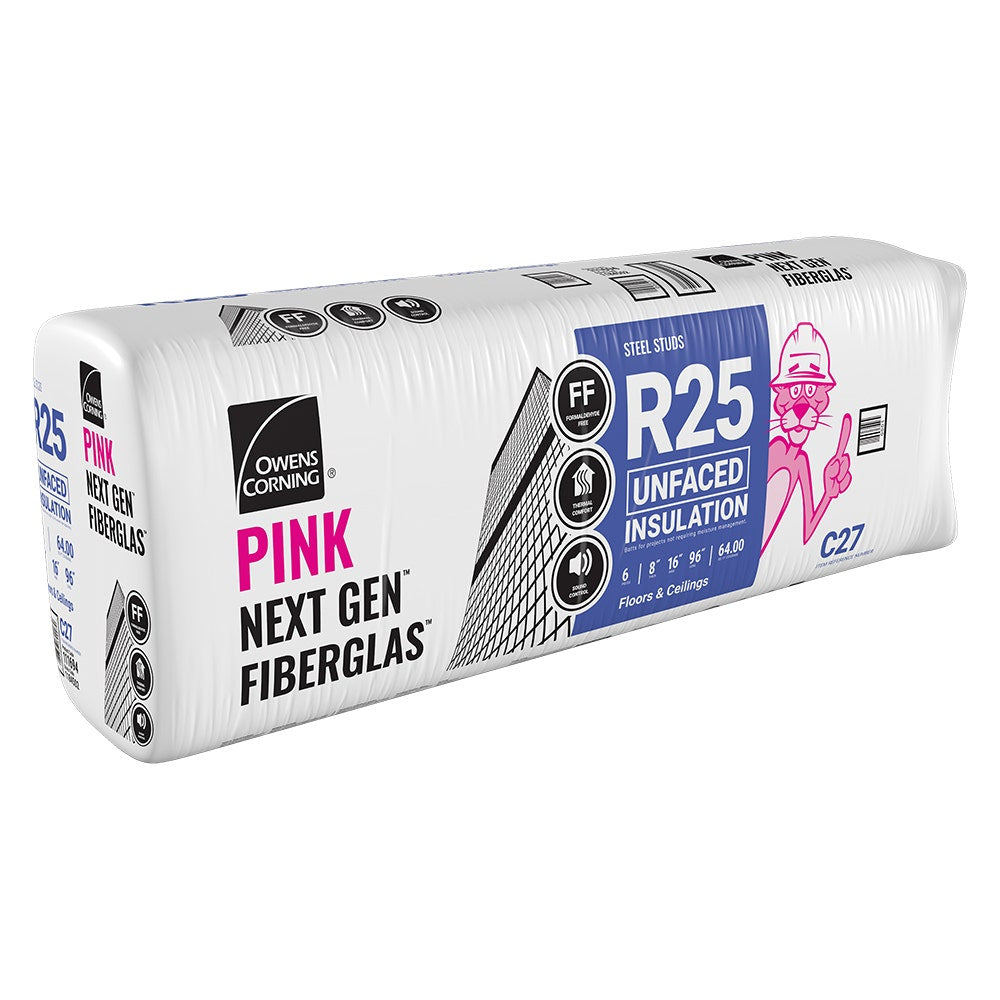
8 in. labeled thickness for R-25-class cavity fill on 16 in. o.c. modules
Key features
96 in. length for four-foot course planning on floors and ceilings
Unfaced format for designer-controlled vapor and smart-retarder strategies
Technical specifications
| R-Value | 25.0 |
|---|---|
| Thickness | 8.0 in |
| Width | 16.0 in |
| Length | 96.0 in |
| Coverage | 64.0 sq ft/pack |
| Material | Fiberglass (PINK Next Gen), unfaced |
| Fire rating | ASTM C665; unfaced glass fibers classified noncombustible per ASTM E136 in manufacturer documentation. Unfaced PINK Next Gen acceptable ICC types I–V per OC literature. |
| Sound rating | Cavity-fill fiberglass improves typical wall STC versus an empty cavity; assembly STC depends on studs, layers, and openings. |
| Density | Light-density flexible batt per ASTM C665 manufacturer listings; see TDS for product-specific values. |
| Thermal conductivity | See manufacturer TDS (ASTM C518) for tested thermal conductivity at labeled R-value. |
| Framing width | 16 in. width for 16 in. on-center joist or stud spacing; verify odd bays at hips and mechanical chases before truck counts. |
| Construction type | Wood-frame and light-gauge metal-frame cavity construction |
| Application area | Wood- and metal-framed walls, floors, roof/ceilings; interior side of basement and unvented crawlspace walls per code and OC literature. |
Product details
About 64 square feet per package (IDI-listed coverage). Primary use: nominal 2×10 floor joists, flat ceilings, and other 16 in. on-center cavities where an 8 in. labeled fiberglass thickness matches the structural depth and the energy model targets R-25-class performance without switching to a different insulation system.
C27 packages PINK Next Gen Fiberglas at 16 in. width for the common 14-1/2 in. clear span in 16 in. o.c. framing, 96 in. length to align with four-foot material staging and modular layouts, and 8 in. labeled thickness as the published R-25 dimension in Owens Corning’s PINK Next Gen unfaced lineup. Unfacing means you coordinate Class I or Class II vapor retarders, smart membranes, or exterior foam separately—useful when the assembly is hybrid or climate-specific.
Installation quality still dominates outcomes: split around ducts and pipes so batts recover to full loft, keep rim joists and penetration clusters continuously aligned with the air barrier, and avoid hiding over-compressed wads behind blocking or utilities because effective R-value is thickness-dependent.
Manufactured to ASTM C665; unfaced glass fiber insulation is classified noncombustible per ASTM E136 in manufacturer documentation, with unfaced PINK Next Gen listed for ICC construction types I through V when installed per OC guidance. GREENGUARD certification with formaldehyde-free validation and a UL Environment EPD support common indoor-air and sustainability submittals.
Cold-climate attic and floor takeoffs often hinge on whether the insulated plane is really continuous after kneewalls, dropped soffits, and mechanical decks—divide net insulated area by about 64 square feet per bag for this SKU and add a field-realistic waste factor.
Submittal discipline: keep the distributor-listed dimensions (8.0 in. × 16.0 in. × 96.0 in.) and about 64.0 square feet per package attached to the same SKU on purchase orders, delivery tickets, and photos for QA. Authoritative tested language and code-oriented statements belong in the current manufacturer technical data sheet at https://www.idi-insulation.com/media/pdfresources/1000132_data_sheet.pdf.
Documents & certifications
Technical data sheet
Manufacturer-tested R-value, coverage, fire notes, and handling—use for submittals, RFIs, and field QA.
Download PDF (opens in new tab)Certifications & compliance
GREENGUARD (formaldehyde-free validated), UL Environment EPD, California Title 24 Article 3 insulating materials
Frequently asked questions
Why pick C27 instead of a wider R-25 unfaced batt such as C28?
Why pick C27 instead of a wider R-25 unfaced batt such as C28?
Match batt width to stud or joist spacing. C27 is 16 in. wide for 16 in. on-center modules; wider SKUs exist for 24 in. o.c. bays. Always verify dimensions and coverage on the master-pack label.
Is unfaced fiberglass enough for vapor control?
Is unfaced fiberglass enough for vapor control?
Vapor control is an assembly decision under IECC and local amendments, not something the batt chooses for you. Unfaced batts cooperate with separate poly, smart membranes, or kraft on another layer when your hygrothermal plan requires it.
How many bags should I order?
How many bags should I order?
Divide net insulated plane area by about 64 square feet per package and add a waste allowance for perimeter cuts, mechanical clusters, and odd triangles.
Does this product meet California Title 24 insulating-material rules?
Does this product meet California Title 24 insulating-material rules?
IDI lists California Code of Regulations Title 24 Chapter 12–13 Article 3 language for this product family—confirm current amendments with your AHJ and cite the linked technical data sheet on submittals.