

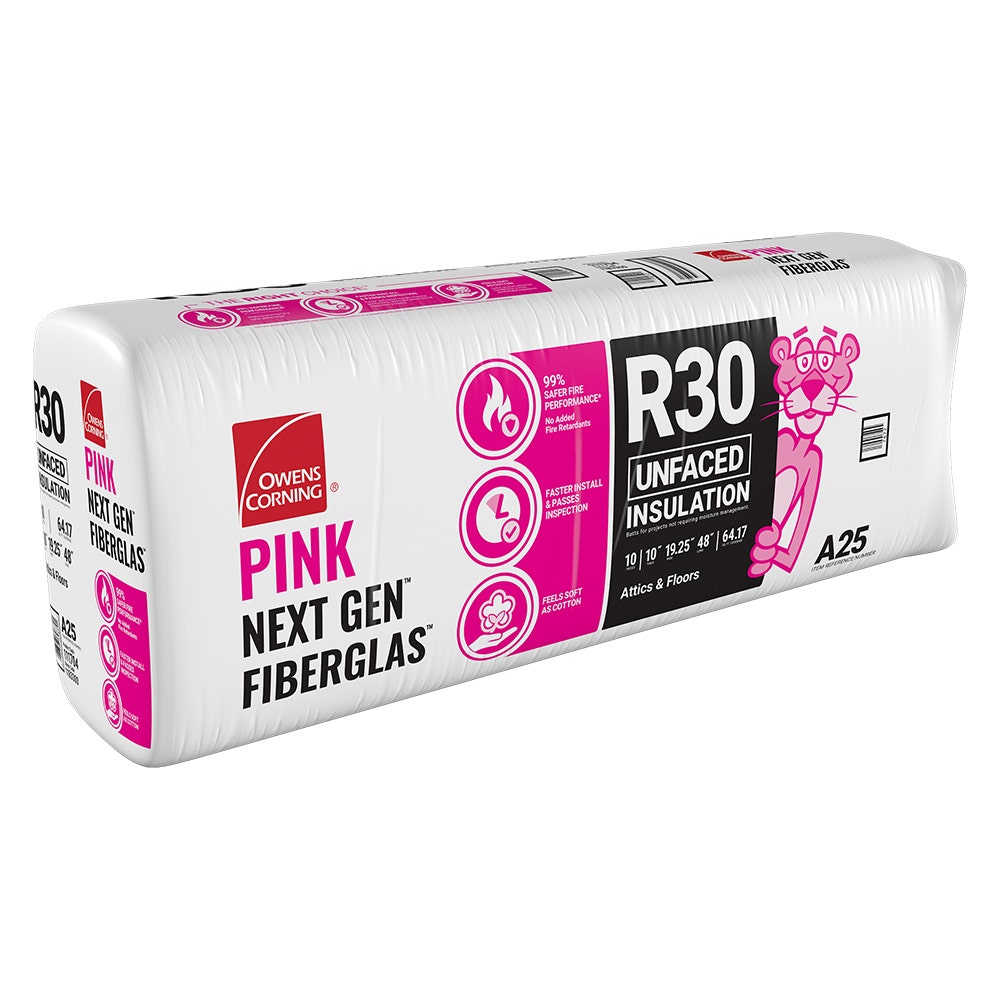
10 in. R-30-class batt sized for attic and ceiling installs with manageable 48 in. lengths
Key features
19.25 in. width targets common joist/truss spacing for edge contact without chronic over-compression
Unfaced format for vented, hybrid, or conditioned attic strategies per designer and code
Technical specifications
| R-Value | 30.0 |
|---|---|
| Thickness | 10.0 in |
| Width | 19.25 in |
| Length | 48.0 in |
| Coverage | 64.17 sq ft/pack |
| Material | Fiberglass (Owens Corning PINK Next Gen™ Fiberglas®, unfaced) |
| Fire rating | ASTM C665 Type I; glass (unfaced) classified noncombustible per ASTM E136. Coordinate rated assemblies with your AHJ when combining with facings, membranes, or foam. |
| Sound rating | Unfaced cavity-fill fiberglass improves typical assembly acoustics versus an empty cavity; field STC depends on framing, openings, and flanking paths. |
| Density | R-30 preformed attic/ceiling batt; supplier part 111704 per IDI / Owens Corning listings |
| Thermal conductivity | Nominal R-value at full labeled thickness; see manufacturer TDS for tested thermal values. |
| Framing width | 19.25 in. width for typical attic joist or truss bottom chord spacing in high-R ceiling applications |
| Construction type | Wood-frame and light-gauge metal-frame cavity construction |
| Application area | Attics, flat ceilings, and sloped ceilings where unfaced R-30 batts meet prescriptive or performance paths; coordinate ventilation, air sealing, and vapor control per assembly |
Product details
A25 is built for attic and sloped-ceiling workflows where installers want serious R per lift without wrestling full-length batts through scuttle openings: 10 in. labeled thickness, 19.25 in. width tuned to common joist spacing, and 48 in. lengths that are easy to carry overhead, stagger per manufacturer guidance, and layer when the assembly calls for incremental R-buildup. Each package covers roughly 64.17 square feet (IDI listing), so always recompute against your truss layout—not every attic matches textbook bay counts.
Unfaced batts keep attic vapor strategies flexible: blown cap over batts, vented vs. conditioned attic transitions, and smart-membrane details at ceiling plane should follow the energy rater’s plan—not a default kraft facing. Compliance remains ASTM C665 manufacturing, ASTM E136 noncombustibility for unfaced glass, Title 24 Article 3 language, GREENGUARD validation, and EPD references for sustainability paperwork.
Safety and durability still dominate outcomes: maintain walkway boards, manage recessed lights per listing, keep soffit baffles open for vented attics, and never compress A25 under stored goods if you want the labeled R-value to survive inspection.
Documents & certifications
Technical data sheet
Manufacturer-tested R-value, coverage, fire notes, and handling—use for submittals, RFIs, and field QA.
Download PDF (opens in new tab)Certifications & compliance
GREENGUARD Certified (formaldehyde-free validated), UL Environment EPD, California Title 24 Article 3 insulating materials, ENERGY STAR® certified per manufacturer listings
Frequently asked questions
Why 19.25 in. width for an R-30 unfaced batt?
Why 19.25 in. width for an R-30 unfaced batt?
That width targets typical attic joist or truss bottom chord spacing so installers get edge contact without chronic over-compression.
Should I ventilate the attic when using high-R batts?
Should I ventilate the attic when using high-R batts?
Ventilation and air sealing strategy are assembly decisions; follow your designer’s attic ventilation and vapor control details.
Can I layer batts to increase R-value?
Can I layer batts to increase R-value?
Only per engineered details—cross-ways layers can work in attics when uncompressed, but do not ad-hoc stack without verifying structure and moisture risk.
What coverage per bag should estimators use?
What coverage per bag should estimators use?
Use the IDI-listed square feet per package (about 64.17 for A25) plus realistic waste for hips, valleys, and skylight curbs.