

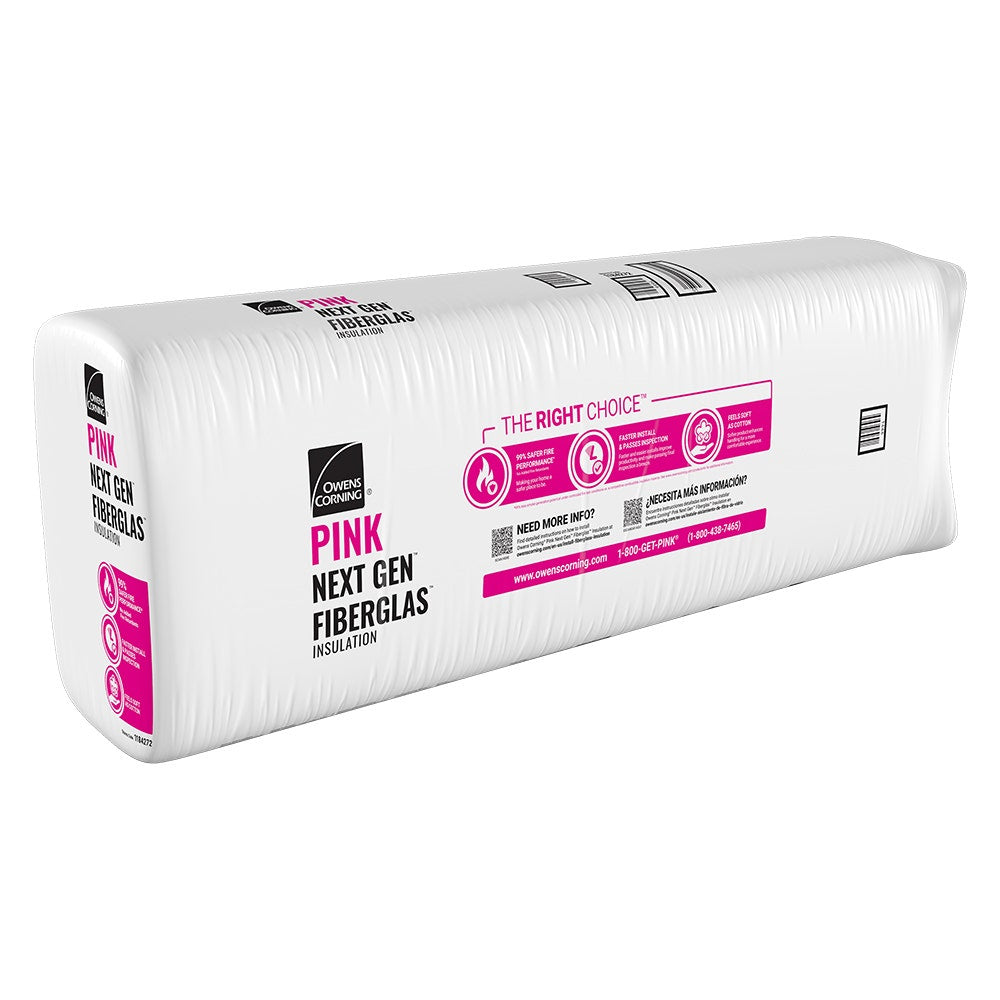
R-30-class performance in an 8.25 in. R-30C thickness
Key features
15.5 in. width for 16 in. o.c. wood framing
Unfaced format for coordinated vapor-control strategies
Technical specifications
| R-Value | 30.0 |
|---|---|
| Thickness | 8.25 in |
| Width | 15.5 in |
| Length | 48.0 in |
| Coverage | 56.83 sq ft/pack |
| Material | Fiberglass (PINK Next Gen), unfaced |
| Fire rating | ASTM C665; unfaced glass fibers classified noncombustible per ASTM E136 in manufacturer documentation. Unfaced PINK Next Gen acceptable ICC types I–V per OC literature. |
| Sound rating | Cavity-fill fiberglass improves typical assembly acoustics versus empty framing; final metrics are assembly-dependent. |
| Density | Light-density flexible batt per ASTM C665 manufacturer listings; see TDS for product-specific values. |
| Thermal conductivity | Labeled R-30C at stated thickness; see manufacturer TDS (ASTM C518) for tested conductivity. |
| Framing width | 15.5 in. width for 16 in. on-center stud or rafter spacing |
| Construction type | Wood-frame and light-gauge metal-frame cavity construction |
| Application area | Cathedral ceilings, confined roof/ceiling cavities, floors; follow venting and vapor plans per code |
Product details
About 56.83 square feet per package (IDI-listed coverage). Primary use: nominal 2×8 or similar assemblies on 16 in. on-center where the energy model demands R-30-class performance but there is not enough depth for a full 10 in. R-30 batt.
R-30C is Owens Corning’s label for that depth-limited high-R story: here 8.25 in. labeled thickness with 15.5 in. width for the common 14-1/2 in. clear bay and 48 in. length for four-foot course planning in roofs, ceilings, and some floor systems. Unfacing removes kraft as a default vapor retarder so your smart membrane, exterior foam, or climate-specific interior strategy stays authoritative.
Field execution still needs disciplined air sealing at sheathing, rim, and penetrations, honest thickness at hips and valleys, and vented-roof airspace maintained above the insulation when the assembly is vented at the deck.
Manufactured to ASTM C665; unfaced glass fiber is noncombustible per ASTM E136 in manufacturer documentation with ICC types I–V language for unfaced PINK Next Gen. GREENGUARD certification with formaldehyde-free validation and a UL Environment EPD support typical submittals. Use the linked TDS for tested values—IDI’s on-page R column may read R-30 while the product name carries the R-30C trade designation.
R-30C batts exist for the cathedral-ceiling and depth-limited ceiling line where raters look for both labeled R-class performance and honest thickness beside vent channels and service voids.
When distributor tables show R-30 in the same row as an R-30C trade name, reconcile the printed bag label and PDF with your energy model before inspection—SKU-level thickness is the lever that actually meets prescriptive packages.
Coordinate manufacturer clearance language for recessed luminaires and chase framing with the TDS so hips and skylight curbs do not silently thin the blanket where photos look fine but probes do not.
Submittal discipline: keep the distributor-listed dimensions (8.25 in. × 15.5 in. × 48.0 in.) and about 56.83 square feet per package attached to the same SKU on purchase orders, delivery tickets, and photos for QA. Authoritative tested language and code-oriented statements belong in the current manufacturer technical data sheet at https://www.idi-insulation.com/media/pdfresources/1000279_data_sheet.pdf.
Documents & certifications
Technical data sheet
Manufacturer-tested R-value, coverage, fire notes, and handling—use for submittals, RFIs, and field QA.
Download PDF (opens in new tab)Certifications & compliance
GREENGUARD (formaldehyde-free validated), UL Environment EPD, California Title 24 Article 3 insulating materials
Frequently asked questions
Is U83 the same cavity module as K71?
Is U83 the same cavity module as K71?
Dimensions and coverage align with the same 16 in. o.c., depth-limited R-30C module family; K71 adds kraft facing for integrated vapor-retarder detailing while U83 ships unfaced for assemblies that place vapor control elsewhere.
Why does the distributor page show R-30 in the spec table?
Why does the distributor page show R-30 in the spec table?
Owens Corning uses the R-30C designation in the product name for depth-limited high-R batts while listing the branded thermal performance in the R-value column. Always confirm thickness, width, length, and coverage against the master-pack label and TDS.
Can I compress U83 to fit under collar ties?
Can I compress U83 to fit under collar ties?
Compression reduces effective R-value. Relieve obstructions, adjust framing, or pick a different SKU rather than squeezing the batt below labeled thickness.
Do I still need vent baffles?
Do I still need vent baffles?
If the roof is vented at the sheathing plane, maintain a clear airway from soffit to ridge above the insulation per code. The batt fills the insulated zone below that channel.