

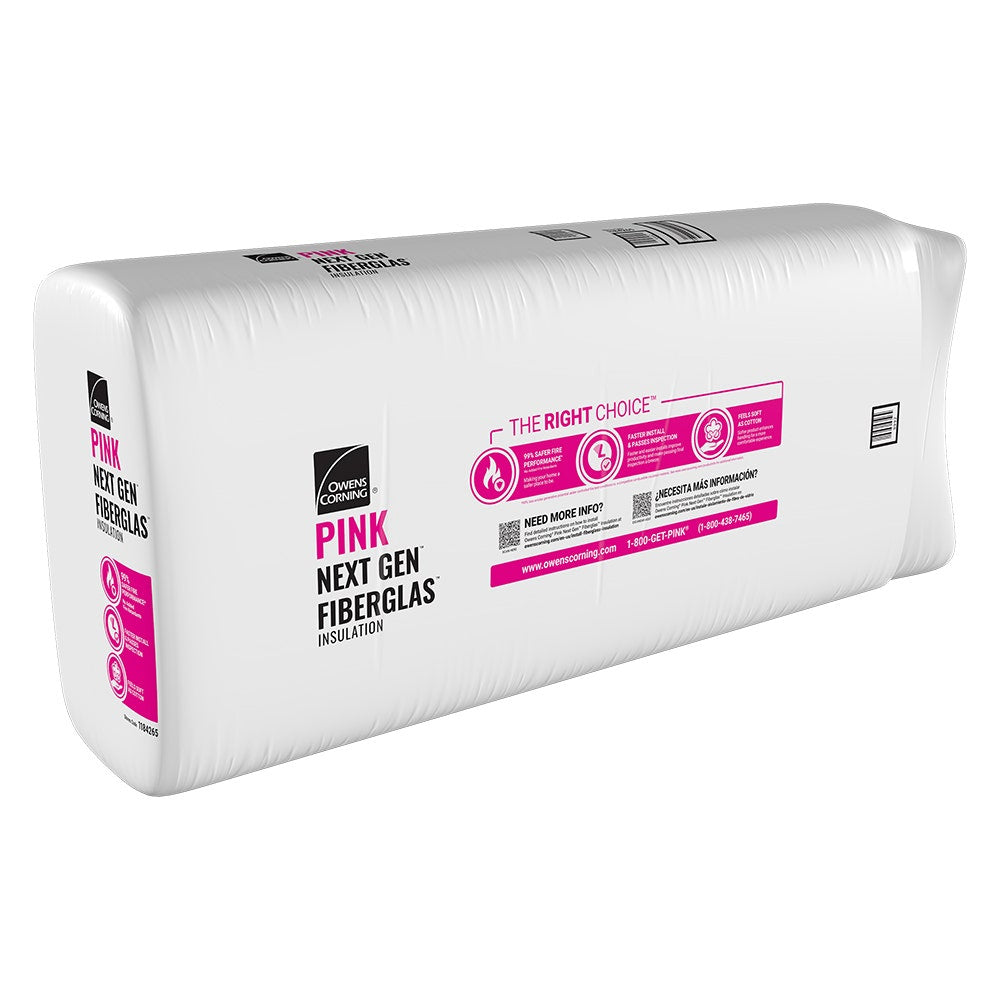
Single-piece width for 24 in. o.c. bays reduces mid-cavity seams versus pairing narrow batts
Key features
R-30-class performance in an 8.25 in. blanket for constrained assemblies
Kraft facing plus Next Gen handling for cleaner high-end ceiling installs
Technical specifications
| R-Value | 30.0 |
|---|---|
| Thickness | 8.25 in |
| Width | 23.75 in |
| Length | 48.0 in |
| Coverage | 79.17 sq ft/pack |
| Material | Fiberglass (PINK Next Gen) with kraft vapor-retarder facing (R-30C confined-cavity product family) |
| Fire rating | ASTM C665 Type I; glass fibers ASTM E136 noncombustible when unfaced. Kraft facing is combustible—follow OC guidance for ICC construction types and rated assemblies. |
| Sound rating | Cavity-fill fiberglass improves typical assembly acoustics versus an empty cavity; STC is framing- and opening-dependent. |
| Density | Higher-density R-30C formulation for labeled R-30 in reduced thickness per manufacturer listings |
| Thermal conductivity | Nominal R-value at full labeled thickness; see manufacturer TDS for tested thermal values. |
| Framing width | 23.75 in. width for nominal 24 in. on-center framing in depth-limited roof and ceiling cavities |
| Construction type | Wood-frame and light-gauge metal-frame cavity construction |
| Application area | Cathedral ceilings, skillion roofs, and wide-module walls where R-30 is required in less than 10 in. depth; coordinate with venting and exterior foam per design |
Product details
About 79.17 sq ft per bag. Primary use: 24 in. on-center bays with limited cavity depth and high R targets. When the module switches to 24 in. on center but the assembly is still depth-starved, you need a batt that is wide enough to fill the bay without a center seam and tall enough in R-value to satisfy the energy model.
K72 is the 23.75 in. wide R-30C kraft-faced option at 8.25 in. thick and 48 in. long, aimed at cathedral ceilings, flat roofs with limited structure, and other cavities where a standard 10 in. R-30 batt simply will not fit. The kraft facing remains a coordinated vapor-retarder layer when your hygrothermal plan places Class I retarders toward the conditioned side in appropriate climates.
Field QC should focus on continuous contact with the air barrier plane, no pillowing against drywall, and honest documentation at hips and valleys where crews love to hide voids. Distributor pages list roughly 79.17 square feet per package—pair that with a real opening takeoff rather than a napkin sketch. Pull the K72 technical data sheet for any prescriptive code package or rater checklist that requires submittals.
K72 extends the R-30C story to 24 in. on-center modules with a 23.75 in. wide kraft-faced batt at 8.25 in. thick and 48 in. long—ideal when wide bays need one continuous piece in cathedral ceilings and skillion roofs with limited structure. Plan takeoffs using about 79.17 square feet per package per distributor pages, not a generic R-30 number from a different geometry. Field-verify bay width on hips and rake transitions where crowned plates change effective spacing, and insist on full loft without wind-washing gaps at skylight curbs.
Kraft facing is still a system layer: align it with IECC vapor-control guidance and any smart membranes or exterior foam in the same wall section. Keep ASTM C665 compliance, GREENGUARD validation, and current data sheet revisions in the submittal set so inspectors and raters see the same story the estimator bid.
Documents & certifications
Technical data sheet
Manufacturer-tested R-value, coverage, fire notes, and handling—use for submittals, RFIs, and field QA.
Download PDF (opens in new tab)Certifications & compliance
GREENGUARD (formaldehyde-free validated), UL Environment EPD, California Title 24 Article 3 insulating materials
Frequently asked questions
Why 23.75 in. width instead of exactly 24 in.?
Why 23.75 in. width instead of exactly 24 in.?
Batt widths are sized to fit net stud or joist spacing for common modules while allowing recovery and edge fit. Always field-verify bay width before assuming a friction fit will land perfectly on every member.
Can I use K72 in a vented attic over a flat ceiling?
Can I use K72 in a vented attic over a flat ceiling?
If depths and clearances match the labeled thickness and your energy consultant approves the assembly, yes. Many projects reserve R-30C lines for sloped ceilings where depth is the real constraint.
Does kraft facing replace a smart vapor retarder in foam-heavy walls?
Does kraft facing replace a smart vapor retarder in foam-heavy walls?
Not automatically. Hybrid walls may need variable-perm strategies. Match the facing to the modeled assembly, not to habit.
How do I document compliance for a rater?
How do I document compliance for a rater?
Keep cut sheets, photos at rough-in showing full-thickness without compression, and air barrier continuity at penetrations. Raters care about installed performance, not just the pink color.