

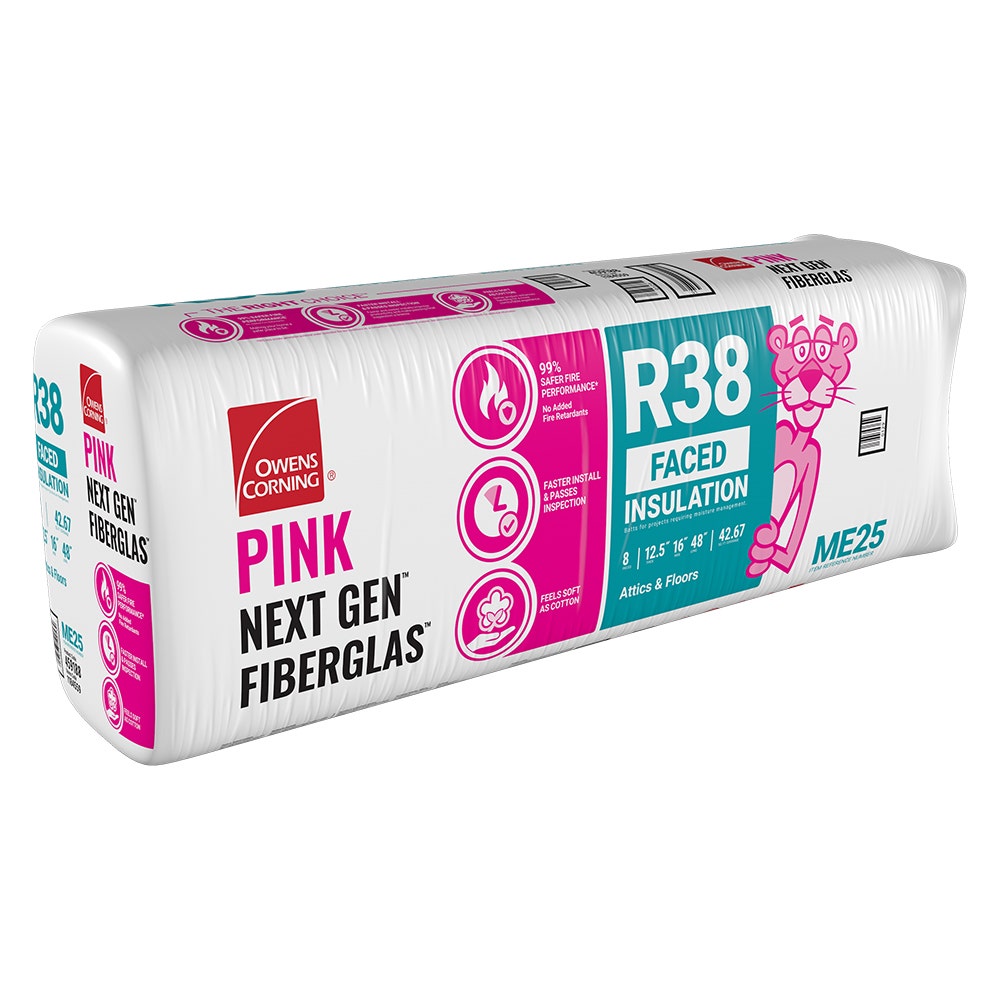
R-38 labeled performance in a 12.5 in. thick kraft-faced batt per IDI listing
Key features
16 in. module width for full-bay coverage on 16 in. o.c. ceilings
48 in. course length for four-foot layout planning in attics and lids
Technical specifications
| R-Value | 38.0 |
|---|---|
| Thickness | 12.5 in |
| Width | 16.0 in |
| Length | 48.0 in |
| Coverage | 42.67 sq ft/pack |
| Material | Fiberglass (PINK Next Gen), kraft-faced |
| Fire rating | ASTM C665; glass fibers ASTM E136 noncombustible when unfaced. Kraft facing is combustible—orient facing per IECC, IRC, and local amendments; kraft-faced PINK Next Gen acceptable ICC construction types III, IV, and V per OC literature. |
| Sound rating | Cavity-fill fiberglass improves typical wall STC versus an empty cavity; assembly STC depends on studs, layers, and openings. |
| Density | Light-density flexible batt per ASTM C665 manufacturer listings; see TDS for product-specific values. |
| Thermal conductivity | See manufacturer TDS (ASTM C518) for tested thermal conductivity at labeled R-value. |
| Framing width | 16 in. width for 16 in. on-center joist or truss bottom chord spacing; verify vent height above insulation in vented roofs. |
| Construction type | Wood-frame and light-gauge metal-frame cavity construction |
| Application area | Wood- and metal-framed walls, floors, roof/ceilings; interior side of basement and unvented crawlspace walls per code and OC literature. |
Product details
About 42.67 square feet per package (IDI-listed coverage). Primary use: wood-framed ceilings, flat attic floors, and compatible roof assemblies on 16 in. on-center framing where the project targets R-38-class cavity performance and a 12.5 in. labeled fiberglass thickness fits the structural depth with venting and finishes still in play.
ME25 packages PINK Next Gen Fiberglas at 16 in. width for the common 14-1/2 in. clear bay, 48 in. length for four-foot course planning, and 12.5 in. labeled thickness as the distributor-listed R-38 dimension. Kraft facing integrates a vapor-retarder layer—orient it per IECC, IRC, and your approved drawings, especially at the lid between conditioned space and vented attics.
Thick high-R batts change logistics: package weights climb, so plan staged loading, protected attic walkways, and hatch reinforcement the same way you would for other deep attic products. Keep eave vents and vent baffles continuous where vented assemblies are required, and avoid compressing batts behind storage platforms.
Manufactured to ASTM C665; glass fibers are treated as noncombustible per ASTM E136 when unfaced in manufacturer documentation, while kraft facing is combustible—follow OC guidance for ignition barriers, recessed luminaires, and occupancy separation. Kraft-faced PINK Next Gen is listed for ICC construction types III, IV, and V when used as documented. GREENGUARD certification with formaldehyde-free validation and a UL Environment EPD support typical submittals.
Cold-climate attic takeoffs often fail when gross footprint is mistaken for insulated plane area after kneewalls, dropped soffits, and mechanical decks interrupt the envelope—model the insulated surface, then divide by about 42.67 square feet per package for this SKU.
Submittal discipline: keep the distributor-listed dimensions (12.5 in. × 16.0 in. × 48.0 in.) and about 42.67 square feet per package attached to the same SKU on purchase orders, delivery tickets, and photos for QA. Authoritative tested language and code-oriented statements belong in the current manufacturer technical data sheet at https://www.idi-insulation.com/media/pdfresources/1004348_data_sheet.pdf.
Documents & certifications
Technical data sheet
Manufacturer-tested R-value, coverage, fire notes, and handling—use for submittals, RFIs, and field QA.
Download PDF (opens in new tab)Certifications & compliance
GREENGUARD (formaldehyde-free validated), UL Environment EPD, California Title 24 Article 3 insulating materials
Frequently asked questions
ME25 versus R-38C depth-limited SKUs such as K90—what is the difference?
ME25 versus R-38C depth-limited SKUs such as K90—what is the difference?
ME25 is a standard-thickness R-38 kraft batt at distributor-listed 12.5 in. labeled thickness per IDI. R-38C products are a different Owens Corning line for constrained cavities—match SKU thickness to your structural depth and energy model.
Do I still need vent baffles with ME25 in a vented attic?
Do I still need vent baffles with ME25 in a vented attic?
If the assembly is vented at the roof plane, maintain a clear, code-height airway from soffit to ridge above the insulation. The batt fills the insulated plane below that ventilation space.
How many bags for my attic?
How many bags for my attic?
Divide net insulated attic floor area by about 42.67 square feet per package and add a waste factor for truss heels, storage decks, and odd triangles.
Can I compress ME25 under a storage platform?
Can I compress ME25 under a storage platform?
Compression reduces effective R-value for fiberglass. Either raise the platform, engineer a detail that preserves thickness, or redesign with rigid foam or a different system.