

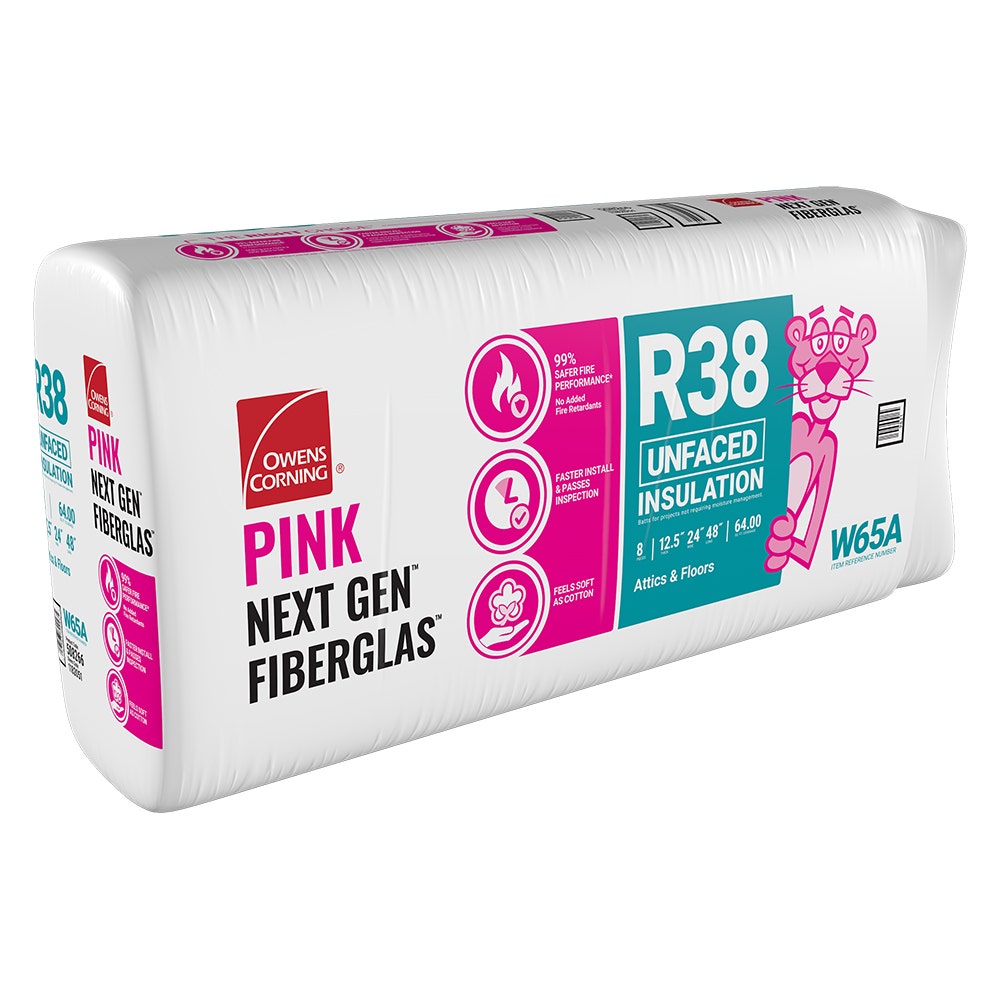
R-38 labeled performance at 12.5 in. thickness for high-R attic and ceiling jobs
Key features
24 in. module width for one-piece coverage in 24 in. o.c. bays
Unfaced format for project-specific vapor and air-barrier coordination
Technical specifications
| R-Value | 38.0 |
|---|---|
| Thickness | 12.5 in |
| Width | 24.0 in |
| Length | 48.0 in |
| Coverage | 64.0 sq ft/pack |
| Material | Fiberglass (PINK Next Gen), unfaced |
| Fire rating | ASTM C665; unfaced glass fibers classified noncombustible per ASTM E136 in manufacturer documentation. Unfaced PINK Next Gen acceptable ICC construction types I through V when installed per Owens Corning literature. |
| Sound rating | Cavity-fill fiberglass improves typical assembly STC versus an empty cavity; final acoustic performance is assembly-dependent. |
| Density | Light-density flexible batt per ASTM C665 manufacturer listings; see TDS for product-specific values. |
| Thermal conductivity | Nominal R-value at labeled thickness; see manufacturer TDS (ASTM C518) for tested conductivity. |
| Framing width | 24 in. width for 24 in. on-center joist, truss, or stud spacing |
| Construction type | Wood-frame and light-gauge metal-frame cavity construction |
| Application area | Attics, floors, and roof/ceilings; wood- and metal-framed cavities per code and Owens Corning literature. |
Product details
About 64 square feet per package (IDI-listed coverage). Primary use: wood- or metal-framed attics, ceilings, and floors where the layout is on 24 in. on-center modules and you want a single 24 in. wide unfaced batt at labeled R-38 performance.
W65 packages PINK Next Gen Fiberglas at 12.5 in. labeled thickness, 24 in. width, and 48 in. length as listed by IDI Insulation. That geometry is aimed at full-width coverage in 24 in. bays so you avoid a mid-bay joint that can telegraph into thermal and air patterns when installation discipline slips. Unfaced batts leave vapor-retarder strategy to the specifier—pair with approved smart membranes, poly, or exterior continuous insulation packages required by IECC and local amendments rather than assuming the insulation layer alone defines moisture control.
Next Gen fiber technology is marketed for softer feel, shed-resistant handling, and quick recovery from compression packaging—practical traits when crews are working overhead in attic lids or between floor joists. Field quality still depends on full labeled thickness (no packing behind utilities), continuous air barrier transitions at rim and penetrations, and preserved vent channels where vented attics or roofs apply.
IDI links the PINK Next Gen Fiberglas insulation product data sheet for tested properties and code-oriented language; submittals should attach distributor-listed dimensions and coverage to the same SKU on purchase orders and delivery tickets. Always verify prescriptive R-values against the adopted energy code for your climate and assembly.
Documents & certifications
Technical data sheet
Manufacturer-tested R-value, coverage, fire notes, and handling—use for submittals, RFIs, and field QA.
Download PDF (opens in new tab)Certifications & compliance
GREENGUARD Gold certified per IDI product listing; UL Environment EPD per manufacturer family documentation; California Title 24 Article 3 insulating materials where applicable.
Frequently asked questions
Why pick W65 instead of a 16 in. wide R-38 batt?
Why pick W65 instead of a 16 in. wide R-38 batt?
Width matches your framing module. W65 is distributor-listed at 24 in. wide for 24 in. on-center bays; 16 in. wide SKUs such as W64 target 16 in. o.c. layouts. Mixing modules creates joints, gaps, or over-compression.
Does unfaced insulation include a vapor retarder?
Does unfaced insulation include a vapor retarder?
No. Unfaced batts do not add factory kraft. Execute vapor control with an approved layer and orientation per IECC, IRC, and your hygrothermal plan.
How many bags should I order?
How many bags should I order?
Divide net insulated plane area by about 64 square feet per package (IDI-listed coverage for W65) and add a waste factor for hips, dormers, and mechanical chases.
Will compressing the batt behind platforms hurt performance?
Will compressing the batt behind platforms hurt performance?
Yes. Fiberglass R-value is thickness-dependent. Preserve full loft or redesign the detail so insulation is not squeezed behind storage or utilities.