

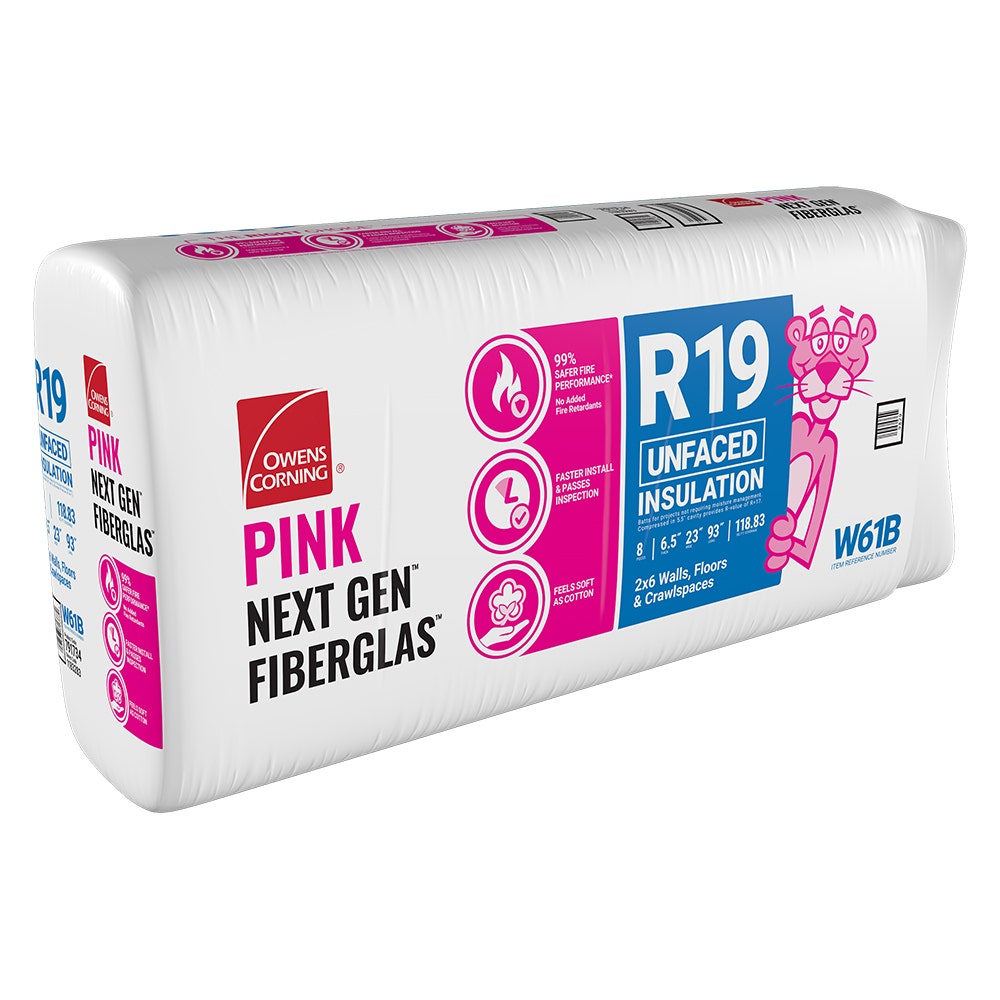
23 in. width for full-bay coverage on 24 in. o.c. framing
Key features
93 in. length aligned with common precut stud packages
Unfaced PINK Next Gen for coordinated vapor-control strategies
Technical specifications
| R-Value | 19.0 |
|---|---|
| Thickness | 6.5 in |
| Width | 23.0 in |
| Length | 93.0 in |
| Coverage | 118.83 sq ft/pack |
| Material | Fiberglass (PINK Next Gen), unfaced |
| Fire rating | ASTM C665; unfaced glass fibers classified noncombustible per ASTM E136 in manufacturer documentation. Unfaced PINK Next Gen acceptable ICC types I–V per OC literature. |
| Sound rating | Cavity-fill fiberglass improves typical wall STC versus an empty cavity; assembly STC remains system-dependent. |
| Density | Light-density flexible batt per ASTM C665 manufacturer listings; see TDS for product-specific values. |
| Thermal conductivity | Labeled R-19 at full labeled thickness; see manufacturer TDS (ASTM C518) for tested conductivity. |
| Framing width | 23 in. width for 24 in. on-center stud spacing in deeper wall cavities |
| Construction type | Wood-frame and light-gauge metal-frame cavity construction |
| Application area | Wood- and metal-framed walls, floors, roof/ceilings; interior side of basement and unvented crawlspace walls per code |
Product details
About 118.83 square feet per package (IDI-listed coverage). Primary use: exterior or interior framed walls on 24 in. on-center spacing where the assembly depth supports roughly 6.5 in. labeled fiberglass thickness for R-19 performance and the specifier wants unfaced cavity fill.
The 23 in. width is sized to fill the common clear span for 24 in. module wood framing in one piece, while the 93 in. length targets precut residential stud packages to reduce vertical cuts versus strictly eight-foot modules. Unfacing keeps Class I vapor-retarder decisions with the designer—critical when you pair cavity fill with exterior foam or smart membranes.
Quality still wins in the field: continuous air barrier at rim and penetrations, honest thickness at corners, and relief cuts at services instead of dense packing.
Manufactured to ASTM C665; unfaced glass fiber is noncombustible per ASTM E136 in manufacturer documentation with ICC types I–V language for unfaced PINK Next Gen. GREENGUARD certification with formaldehyde-free validation and a UL Environment EPD support typical submittals. Use the linked TDS for tested properties and package weights.
Six-and-a-half-inch labeled thickness signals deeper nominal 2×8-class wall modules on 24 in. centers; estimators should not assume 2×6 stock depths when reading schedules.
Metal stud projects may still use wide-module batts, but thermal bridging and liner requirements differ from wood framing—coordinate details with the structural and energy consultants.
Submittals should spell out facing orientation against IECC and local amendments in humid or mixed climates where Class I vapor retarders on the wrong plane create liability for designers, not installers guessing in the field.
The manufacturer PDF is the right place to confirm nominal R-value at full labeled thickness and to compare surface burning characteristics for kraft-faced products with unfaced glass fiber listings on the same product family page.
Submittal discipline: keep the distributor-listed dimensions (6.5 in. × 23.0 in. × 93.0 in.) and about 118.83 square feet per package attached to the same SKU on purchase orders, delivery tickets, and photos for QA. Authoritative tested language and code-oriented statements belong in the current manufacturer technical data sheet at https://www.idi-insulation.com/media/pdfresources/1000282_data_sheet.pdf.
Documents & certifications
Technical data sheet
Manufacturer-tested R-value, coverage, fire notes, and handling—use for submittals, RFIs, and field QA.
Download PDF (opens in new tab)Certifications & compliance
GREENGUARD (formaldehyde-free validated), UL Environment EPD, California Title 24 Article 3 insulating materials
Frequently asked questions
Is W61 for 2×6 or 2×8 walls?
Is W61 for 2×6 or 2×8 walls?
The 6.5 in. labeled thickness targets deeper cavities than standard 2×4 stock—commonly nominal 2×8 walls on 24 in. centers. Always match labeled thickness to your structural cavity depth and energy model.
W61 versus kraft-faced options at the same module?
W61 versus kraft-faced options at the same module?
Choose unfaced W61 when vapor retarders live in another layer. Choose a kraft-faced SKU when the assembly designer wants integrated mill-applied Class I vapor retarder facing.
How do I estimate bags?
How do I estimate bags?
Divide net insulated wall area by about 118.83 square feet per bag and add a waste factor for openings and cuts.
Does unfaced R-19 satisfy air tightness?
Does unfaced R-19 satisfy air tightness?
No. Batts are not an air barrier. Detail taped sheathing, membranes, or interior air control per the assembly.