

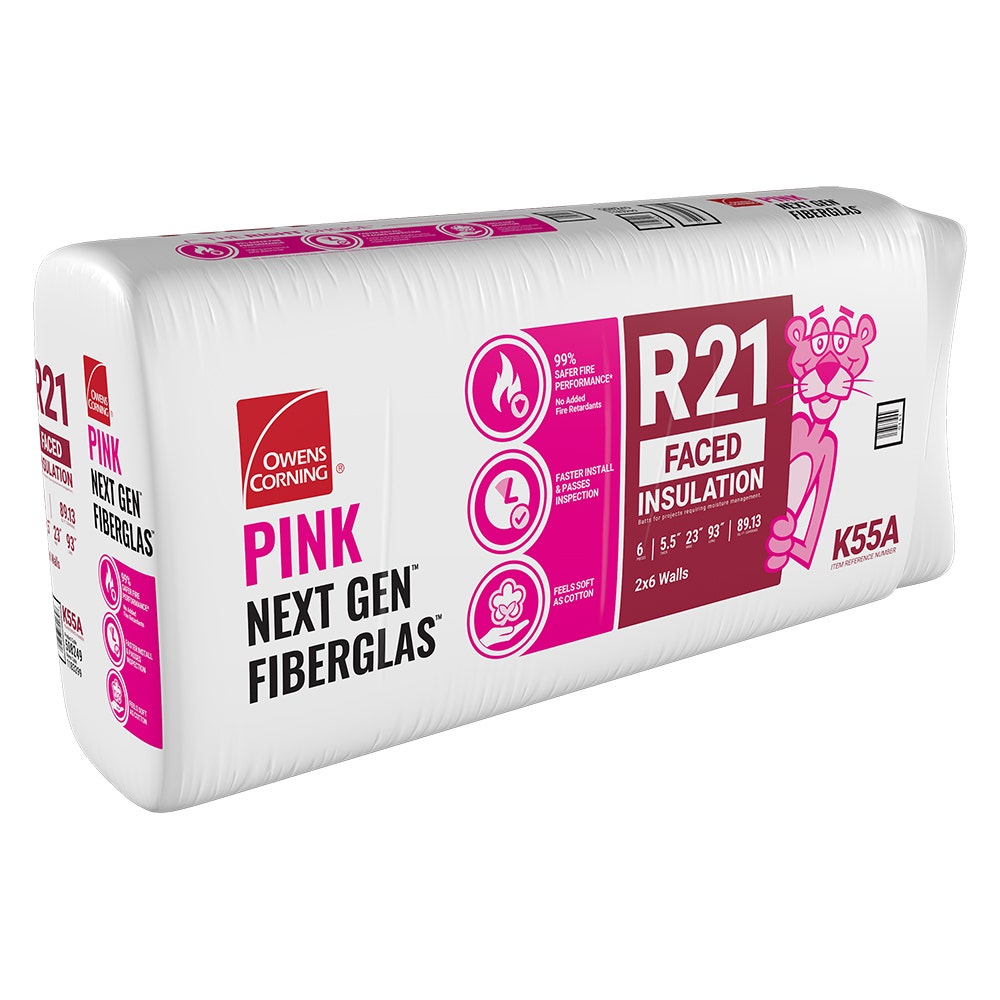
23 in. width matches 24 in. o.c. stud bays to reduce mid-cavity seams
Key features
93 in. length suits common precut stud packages used in residential framing
Next Gen fiber handling plus kraft facing for coordinated vapor-control details
Technical specifications
| R-Value | 21.0 |
|---|---|
| Thickness | 5.5 in |
| Width | 23.0 in |
| Length | 93.0 in |
| Coverage | 89.13 sq ft/pack |
| Material | Fiberglass (PINK Next Gen) with kraft vapor-retarder facing |
| Fire rating | ASTM C665 Type I; glass fibers ASTM E136 noncombustible when unfaced. Kraft facing is combustible—follow OC guidance for ICC construction types and rated assemblies. |
| Sound rating | Cavity-fill fiberglass improves typical wall STC versus an empty cavity; final acoustic performance is assembly-dependent. |
| Density | Light-density flexible batt per ASTM C665 manufacturer Type I listings |
| Thermal conductivity | Nominal R-21 at full labeled thickness; see manufacturer TDS for tested conductivity values |
| Framing width | 23 in. width for nominal 2x6 walls at 24 in. on-center stud spacing |
| Construction type | Wood-frame and light-gauge metal-frame cavity construction |
| Application area | Exterior/interior walls, floors, and roof/ceilings; interior side of basement and unvented crawlspace walls per code |
Product details
About 89.13 sq ft per bag. Primary use: 2x6 walls on 24 in. on-center framing. Twenty-four-inch stud spacing saves lumber and speeds framing, but insulation has to widen with the bay or you invite a stripe of convective looping down each stud line.
K55 is the Owens Corning PINK Next Gen R-21 kraft-faced batt cut to 23 in. wide with a 93 in. length for nominal 2x6 depth, so each piece is intended to fill a 24 in. o.c. cavity in one pass instead of cobbling two narrow batts with a mid-bay seam. The thermal story is straightforward labeled R-value at full thickness, while the practical story is fewer edge gaps and less labor fighting mis-matched widths on production tracks. Next Gen fibers keep the product more pleasant to handle, and kraft facing continues to support vapor-retarder strategies where the assembly designer wants a Class I retarder on the conditioned side in climate-appropriate details.
Distributor spec pages list roughly 89.13 square feet per package—use that in takeoffs, then reconcile to architectural SF and opening deductions. Pay special attention at corners and intersecting walls where 24 in. modules can drift; field-verify a few bays before you commit entire bundles. K55 is the 23 in. wide R-21 kraft-faced batt at 5.5 in. thick by 93 in. long for nominal 2×6 walls on 24 in. centers—one piece across the bay instead of stitching two narrow batts with a mid-cavity seam.
Distributor spec pages show about 89.13 square feet per package; field-verify stud spacing on hips and corners where 24 in. modules can drift. Next Gen handling keeps production predictable, while kraft facing supports vapor-retarder strategies that still need to be checked against hybrid foam stacks and climate-zone guidance. Energy models should update framing fraction when switching from 16 in. to 24 in. modules because whole-wall U-factor changes even if cavity R-label looks identical.
Document rough-in photos at plates, rim, and intersecting walls so QA proves continuous contact and thickness, not just pink color visible at the face.
Documents & certifications
Technical data sheet
Manufacturer-tested R-value, coverage, fire notes, and handling—use for submittals, RFIs, and field QA.
Download PDF (opens in new tab)Certifications & compliance
GREENGUARD (formaldehyde-free validated), UL Environment EPD, California Title 24 Article 3 insulating materials
Frequently asked questions
Will a 23 in. batt fit my 24 in. layout?
Will a 23 in. batt fit my 24 in. layout?
It is designed for nominal 24 in. on-center framing, but verify actual stud spacing and bowed members in the field. Severely crowned plates can change effective bay width.
Do wider batts change my thermal bridging model?
Do wider batts change my thermal bridging model?
Changing stud spacing changes framing fraction and whole-wall U-factor even if cavity R-value is unchanged. Update your WUFI or RESNET inputs when switching from 16 in. to 24 in. modules.
Can I rip this batt for odd bays?
Can I rip this batt for odd bays?
You can knife-cut fiberglass, but ripping wide batts into undersized strips often yields poor edge fill. Use the correct SKU for each bay width whenever possible.
Is kraft facing compatible with exterior rigid foam?
Is kraft facing compatible with exterior rigid foam?
Many hybrid walls use exterior foam with interior vapor control that is not a simple Class I kraft sheet. Follow your climate zone guidance and the assembly-specific details from the architect—not every foam stack wants interior kraft.