

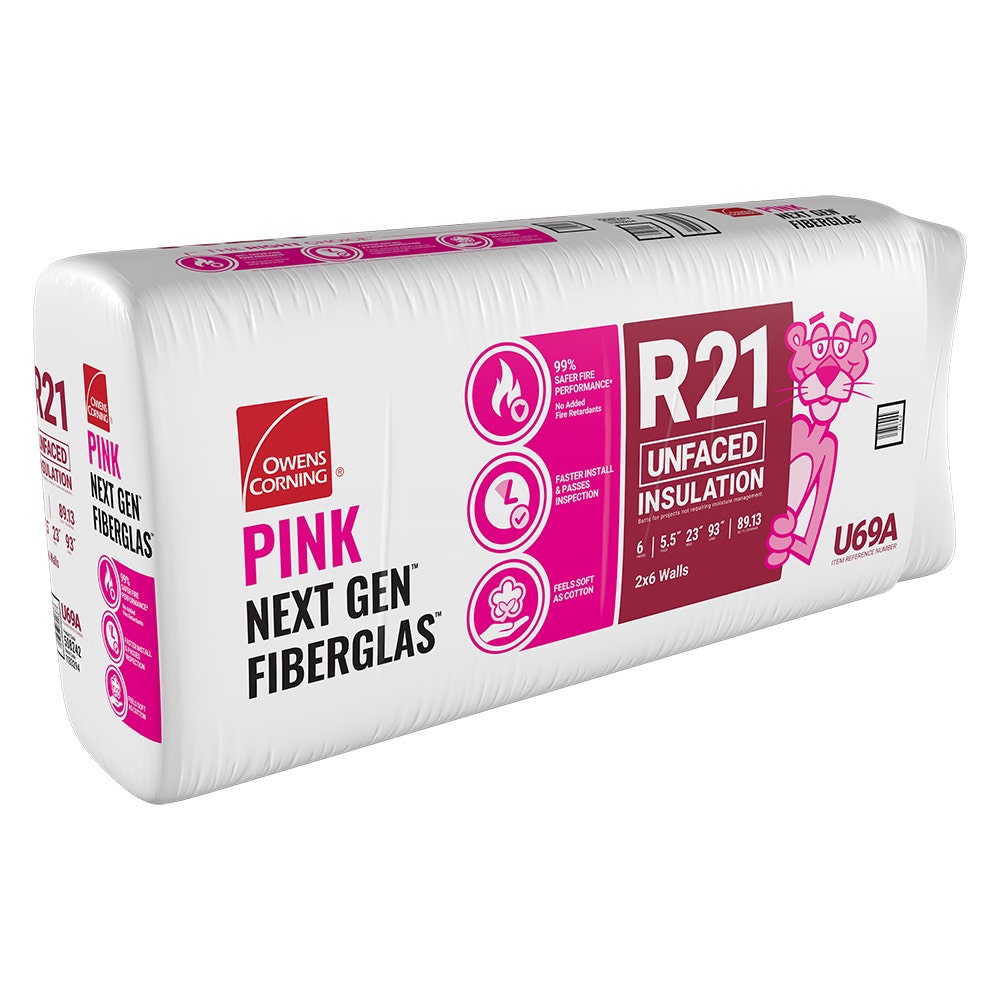
23 in. width for one-piece 24 in. o.c. 2×6 stud bays
Key features
93 in. length for precut residential stud workflows
Unfaced PINK Next Gen for designer-controlled vapor detailing
Technical specifications
| R-Value | 21.0 |
|---|---|
| Thickness | 5.5 in |
| Width | 23.0 in |
| Length | 93.0 in |
| Coverage | 89.13 sq ft/pack |
| Material | Fiberglass (PINK Next Gen), unfaced |
| Fire rating | ASTM C665; unfaced glass fibers classified noncombustible per ASTM E136 in manufacturer documentation. Unfaced PINK Next Gen acceptable ICC types I–V per OC literature. |
| Sound rating | Cavity-fill fiberglass improves typical assembly acoustics versus empty framing; final metrics are assembly-dependent. |
| Density | Light-density flexible batt per ASTM C665 manufacturer listings; see TDS for product-specific values. |
| Thermal conductivity | Nominal R-21 at full labeled thickness; see manufacturer TDS (ASTM C518) for tested conductivity. |
| Framing width | 23 in. width for 24 in. on-center stud spacing in nominal 2×6 walls |
| Construction type | Wood-frame and light-gauge metal-frame cavity construction |
| Application area | Wood- and metal-framed walls, floors, roof/ceilings; interior side of basement and unvented crawlspace walls per code |
Product details
About 89.13 square feet per package (IDI-listed coverage). Primary use: nominal 2×6 walls on 24 in. on-center framing where the specifier wants unfaced R-21 cavity fill with precut-height logistics.
The geometry mirrors the familiar wide-module wood-frame pattern: 23 in. batt width for 24 in. o.c. spacing, 5.5 in. labeled thickness for R-21 at full recovery, and 93 in. length to reduce vertical cuts versus strictly 96 in. stock on nine-foot plate lines. Unfacing keeps vapor retarder placement where the energy model and IECC amendments require it instead of inheriting mill-applied kraft.
Quality control is still hand work: maintain continuous air barriers at rim and penetrations, split batts around boxes without dense wads, and document full loft for raters.
Manufactured to ASTM C665; unfaced glass fiber is noncombustible per ASTM E136 in manufacturer documentation with ICC types I–V language for unfaced PINK Next Gen. GREENGUARD and UL Environment EPD documentation match the rest of the line. Download the TDS for authoritative properties.
Precut 93 in. lengths interact with plate heights, platform framing, and slab tolerance—field-verify a representative stack height before locking vertical joint patterns on long elevations.
Unfaced R-21 in deeper 2×6-class cavities is frequently paired with exterior foam or interior smart membranes; the batt does not replace those layers, it fills the cavity once the assembly designer places them.
Distributor tables tie unfaced R-21 batts in this geometry to full labeled thickness at studs; blower-door and IR callbacks still cluster at outlet banks and rim lines where compression erases effective R before the nominal SKU is questioned.
Use the linked technical data sheet for ASTM C665 Type I flexible batt language, handling guidance, and tested physical properties tied to this catalog number rather than a generic unfaced R-21 note from another width module.
Submittal discipline: keep the distributor-listed dimensions (5.5 in. × 23.0 in. × 93.0 in.) and about 89.13 square feet per package attached to the same SKU on purchase orders, delivery tickets, and photos for QA. Authoritative tested language and code-oriented statements belong in the current manufacturer technical data sheet at https://www.idi-insulation.com/media/pdfresources/1000290_data_sheet.pdf.
Documents & certifications
Technical data sheet
Manufacturer-tested R-value, coverage, fire notes, and handling—use for submittals, RFIs, and field QA.
Download PDF (opens in new tab)Certifications & compliance
GREENGUARD (formaldehyde-free validated), UL Environment EPD, California Title 24 Article 3 insulating materials
Frequently asked questions
U69 versus kraft-faced K55 at the same module?
U69 versus kraft-faced K55 at the same module?
K55 includes kraft facing for Class I vapor-retarder detailing when your assembly allows it. U69 is unfaced—use it when vapor control is specified on another layer or when the designer bans factory kraft in that cavity.
Can I use U69 in 16 in. o.c. 2×6 walls?
Can I use U69 in 16 in. o.c. 2×6 walls?
A 23 in. wide batt is sized for 24 in. on-center bays. For 16 in. o.c. 2×6, select a 15 or 15.25 in. wide R-21 SKU family and verify coverage on its data sheet.
How should I store bundles on site?
How should I store bundles on site?
Keep bags dry, off soil, and slit carefully so batts recover before installation. Wet or permanently crushed packs should not be buried in the wall.
Does this batt satisfy my energy model alone?
Does this batt satisfy my energy model alone?
R-value on the label assumes full-thickness, gap-free installation with aligned air and thermal barriers. Model the whole assembly including framing factor, exterior CI, and air leakage.