

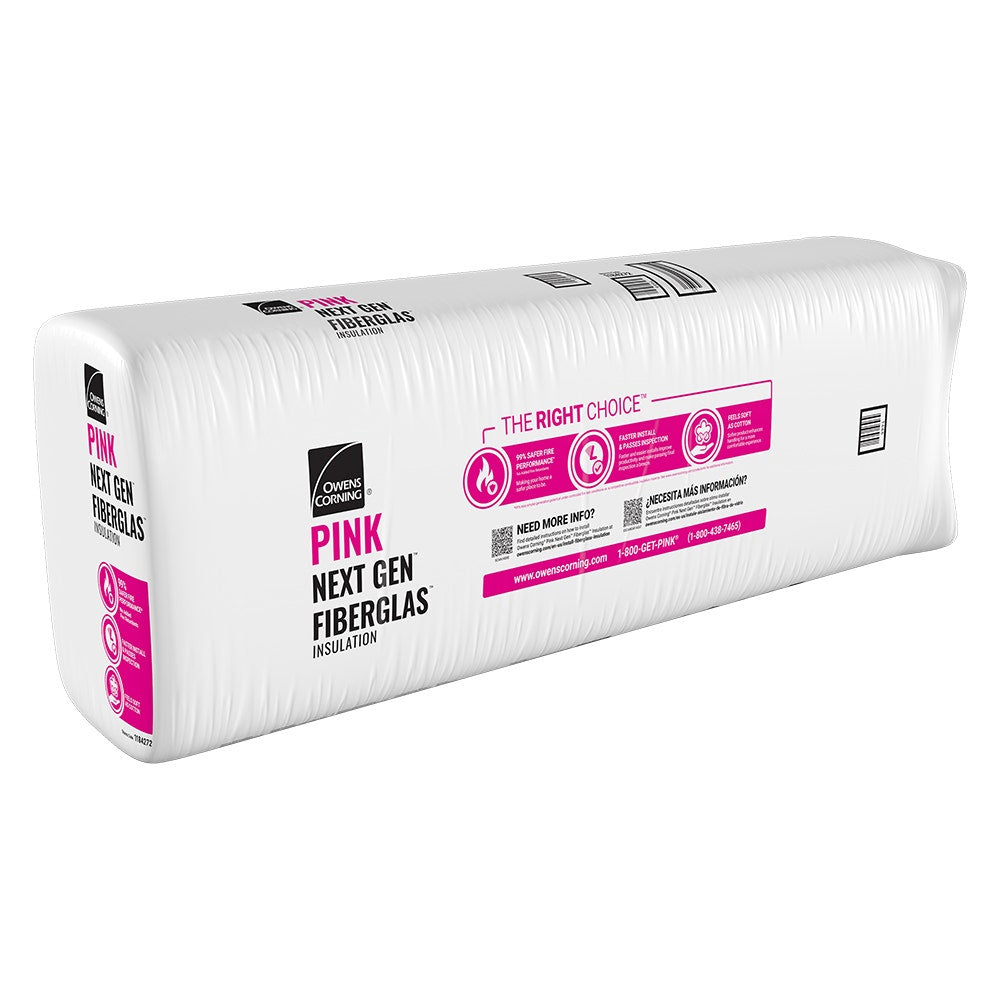
R-38-class performance in a 10.25 in. R-38C thickness for tight cavities
Key features
15.5 in. width aligned with 16 in. o.c. wood framing
Unfaced format for coordinated vapor-control and smart-retarder strategies
Technical specifications
| R-Value | 38.0 |
|---|---|
| Thickness | 10.25 in |
| Width | 15.5 in |
| Length | 48.0 in |
| Coverage | 41.33 sq ft/pack |
| Material | Fiberglass (PINK Next Gen), unfaced |
| Fire rating | ASTM C665; unfaced glass fibers classified noncombustible per ASTM E136 in manufacturer documentation. Unfaced PINK Next Gen acceptable ICC types I–V per OC literature. |
| Sound rating | Cavity-fill fiberglass improves typical assembly acoustics versus empty framing; final metrics are assembly-dependent. |
| Density | Light-density flexible batt per ASTM C665 manufacturer listings; see TDS for product-specific values. |
| Thermal conductivity | Labeled R-38C at stated thickness; see manufacturer TDS (ASTM C518) for tested conductivity. |
| Framing width | 15.5 in. width for 16 in. on-center stud or rafter spacing; field-verify narrow bays at hips and valleys. |
| Construction type | Wood-frame and light-gauge metal-frame cavity construction |
| Application area | Wood- and metal-framed walls, floors, roof/ceilings; interior side of basement and unvented crawlspace walls per code and OC literature. |
Product details
About 41.33 square feet per package (IDI-listed coverage). Primary use: high-R roof and ceiling assemblies on 16 in. on-center framing where a standard R-38 batt thickness will not fit with venting, drywall lids, and structural members still in play.
R-38C exists for exactly that mismatch between code minimum R-values climbing toward R-38 or higher and the stubborn refusal of rafter or truss bottom chords to grow. C18 delivers labeled R-38-class performance at a published 10.25 in. thickness—Owens Corning’s R-38C line—while the 15.5 in. width tracks the common 14-1/2 in. clear bay for 16 in. o.c. wood framing. The 48 in. length matches typical four-foot module layouts so crews can plan courses without inventing odd lap rules mid-slope.
Because this SKU is unfaced, you keep vapor strategy on the designer’s side of the submittal: pair it with approved vapor retarders, exterior foam, or smart membranes as your climate zone requires instead of inheriting kraft orientation from the insulation plant. Installation quality still dominates: maintain vent airspace per code above the insulation in vented assemblies, keep insulation thickness honest at eaves and hips, and do not compress batts behind recessed fixtures unless the luminaire is IC-rated and the detail is approved.
Manufacturing compliance is ASTM C665; unfaced glass fiber is treated as noncombustible per ASTM E136 in manufacturer documentation, with unfaced PINK Next Gen listed for ICC construction types I through V when installed per OC guidance. GREENGUARD certification with formaldehyde-free validation and a UL Environment EPD answer common indoor-air and LEED documentation requests. Always use the linked technical data sheet for authoritative tested values and code language before inspection.
Depth-limited high-R roof assemblies are where R-38C products earn their keep: the code path wants R-38-class performance, but vent baffles, structural members, and finish tolerances refuse a full 12.5 in. fiberglass thickness.
Field sequencing matters—install baffles and air barrier transitions before crews compress batts trying to “make it fit” at eaves; compression is the fastest way to lose labeled performance in fiberglass.
Submittal discipline: keep the distributor-listed dimensions (10.25 in. × 15.5 in. × 48.0 in.) and about 41.33 square feet per package attached to the same SKU on purchase orders, delivery tickets, and photos for QA. Authoritative tested language and code-oriented statements belong in the current manufacturer technical data sheet at https://www.idi-insulation.com/media/pdfresources/1000070_data_sheet.pdf.
Documents & certifications
Technical data sheet
Manufacturer-tested R-value, coverage, fire notes, and handling—use for submittals, RFIs, and field QA.
Download PDF (opens in new tab)Certifications & compliance
GREENGUARD (formaldehyde-free validated), UL Environment EPD, California Title 24 Article 3 insulating materials
Frequently asked questions
Some listings say 45 in. length—what length is C18?
Some listings say 45 in. length—what length is C18?
IDI’s specification table for this SKU lists 48 in. length with 41.33 sq ft per package. Always confirm length, width, thickness, and coverage on the master-pack label before you cut in-place and before you argue with an inspector.
Can I leave unfaced fiberglass exposed in a garage or attic?
Can I leave unfaced fiberglass exposed in a garage or attic?
Building codes generally require a thermal or ignition barrier on the living-space side and may restrict exposed insulation in garages. Treat unfaced batts like any other cavity insulation: follow IECC, IRC, and local amendments for protection and occupancy separation.
How is R-38C different from standard R-38 batts?
How is R-38C different from standard R-38 batts?
R-38C batts deliver labeled high-R performance at a published thickness that fits constrained cavities—here 10.25 in. labeled thickness for the R-38C line—where a full-thickness conventional R-38 batt would not fit with venting and finishes.
Do I still need vent baffles with this product?
Do I still need vent baffles with this product?
If the assembly is vented at the roof plane, yes—keep a clear, code-height airway from soffit to ridge above the insulation. The batt does not replace ventilation detailing; it fills the insulated plane below it.