

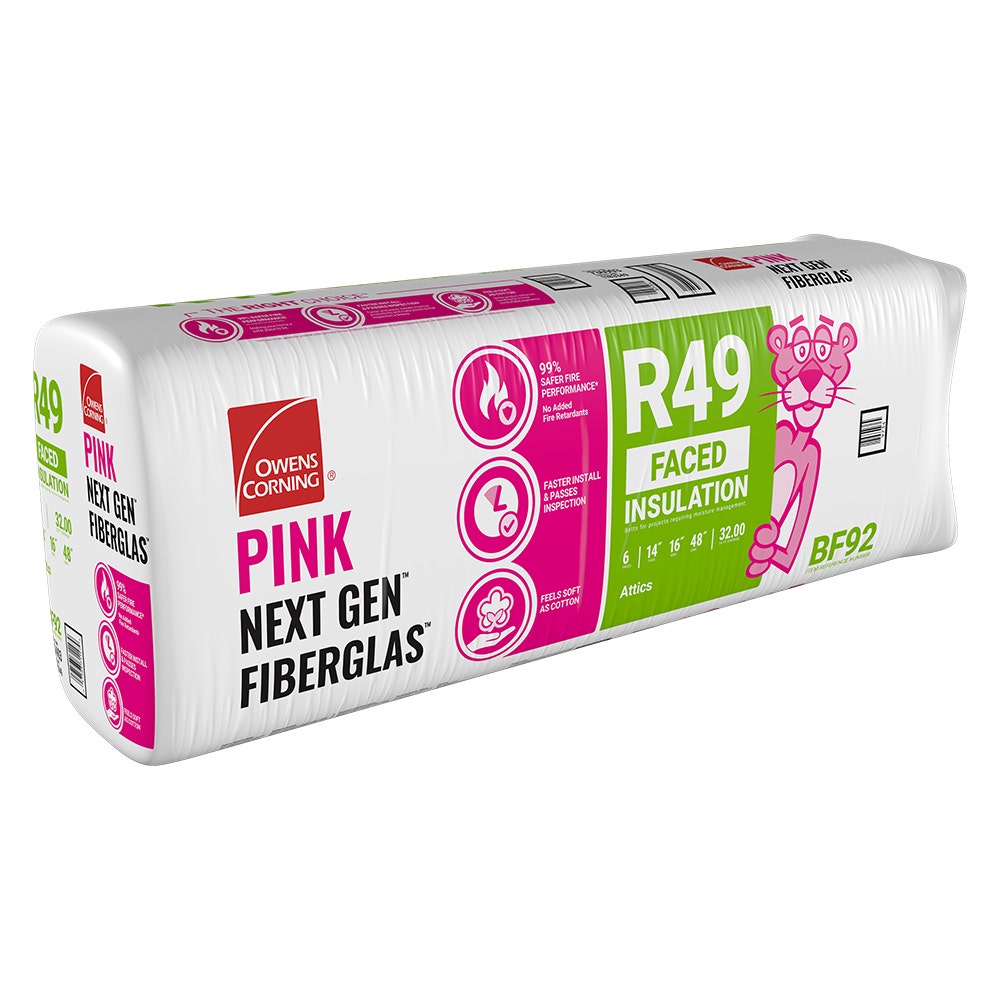
16 in. width for 16 in. o.c. high-R attic and ceiling modules
Key features
Kraft facing supports Class I vapor-retarder detailing when code allows
PINK Next Gen handling with improved recovery after compression packaging
Technical specifications
| R-Value | 49.0 |
|---|---|
| Thickness | 14.0 in |
| Width | 16.0 in |
| Length | 48.0 in |
| Coverage | 32.0 sq ft/pack |
| Material | Fiberglass (PINK Next Gen) with kraft vapor-retarder facing |
| Fire rating | ASTM C665 Type I; glass fibers ASTM E136 noncombustible when unfaced. Kraft facing is combustible—follow OC guidance for ICC construction types and rated assemblies. |
| Sound rating | Thick cavity fill improves typical ceiling acoustics versus bare joists; assembly results depend on layers and penetrations. |
| Density | Light-density flexible batt per ASTM C665 manufacturer listings; see TDS for product-specific values. |
| Thermal conductivity | Labeled R-49 at stated thickness; see manufacturer TDS (ASTM C518) for tested conductivity. |
| Framing width | 16 in. width for 16 in. on-center joist or truss spacing |
| Construction type | Wood-frame and light-gauge metal-frame cavity construction |
| Application area | Attics, ceilings, and framed cavities where kraft-faced R-49 batts are specified |
Product details
About 32 square feet per package (IDI-listed coverage). Primary use: attic floors, flat ceilings, and compatible framed cavities on 16 in. on-center modules where the assembly calls for kraft-faced R-49 batts in a 16 in. wide piece rather than the 24 in. BF93 geometry.
BF92 carries the same 14 in. labeled thickness as other R-49 batts in this line but trims width to 16 in. so crews working sixteen-inch modules do not have to rip wide batts in the truss yard. Kraft facing integrates a Class I vapor retarder on the warm-in-winter side when your climate package allows that strategy—never treat facing as an air barrier by itself.
Field quality still means vented-roof airspace where required, continuous air sealing, and full loft without compression at mechanical platforms.
Manufactured to ASTM C665. Glass fibers are noncombustible per ASTM E136 when unfaced; kraft facing burns—follow OC guidance for ICC construction types III, IV, and V for faced products. GREENGUARD certification with formaldehyde-free validation and a UL Environment EPD support typical submittals. Use the linked installation guide and TDS for authoritative values.
Sixteen-inch on-center high-R attic modules differ from twenty-four-inch modules in the same R-49 family—width drives bag count and labor even when thickness matches.
Kraft orientation and attic ventilation remain coupled decisions: vented attics still need a clear airway above the insulation while the facing plane follows your vapor strategy below.
Prescriptive attic tables care about net insulated ceiling area over conditioned space; reconcile distributor-listed square feet per bag with field-measured slope and perimeter before locking truck counts.
ASTM C665 Type I and GREENGUARD documentation paths for PINK Next Gen are commonly bundled on distributor collateral; attic ventilation still needs net free intake and exhaust math per IRC, independent of the insulation SKU alone.
Submittal discipline: keep the distributor-listed dimensions (14.0 in. × 16.0 in. × 48.0 in.) and about 32.0 square feet per package attached to the same SKU on purchase orders, delivery tickets, and photos for QA. Authoritative tested language and code-oriented statements belong in the current manufacturer technical data sheet at https://www.idi-insulation.com/media/pdfresources/1000962_data_sheet.pdf.
Documents & certifications
Technical data sheet
Manufacturer-tested R-value, coverage, fire notes, and handling—use for submittals, RFIs, and field QA.
Download PDF (opens in new tab)Certifications & compliance
GREENGUARD (formaldehyde-free validated), UL Environment EPD, California Title 24 Article 3 insulating materials
Frequently asked questions
BF92 versus BF93?
BF92 versus BF93?
BF92 is 16 in. wide for 16 in. on-center modules. BF93 is 24 in. wide for 24 in. on-center modules. Both are kraft-faced R-49 at 14 in. labeled thickness with 32 and 48 square feet per bag respectively per IDI.
Can I leave kraft facing exposed?
Can I leave kraft facing exposed?
No. Kraft burns and is not a finished surface. Provide the required thermal or ignition barrier per code.
Which way should the facing install?
Which way should the facing install?
Follow IECC, local amendments, and the project vapor-control strategy—often toward the warm-in-winter side in heating-dominated climates, but mixed climates can differ.
How many bags for my attic?
How many bags for my attic?
Divide net insulated attic floor area by 32 square feet per bag and add waste for hips, drops, and mechanical chases.