

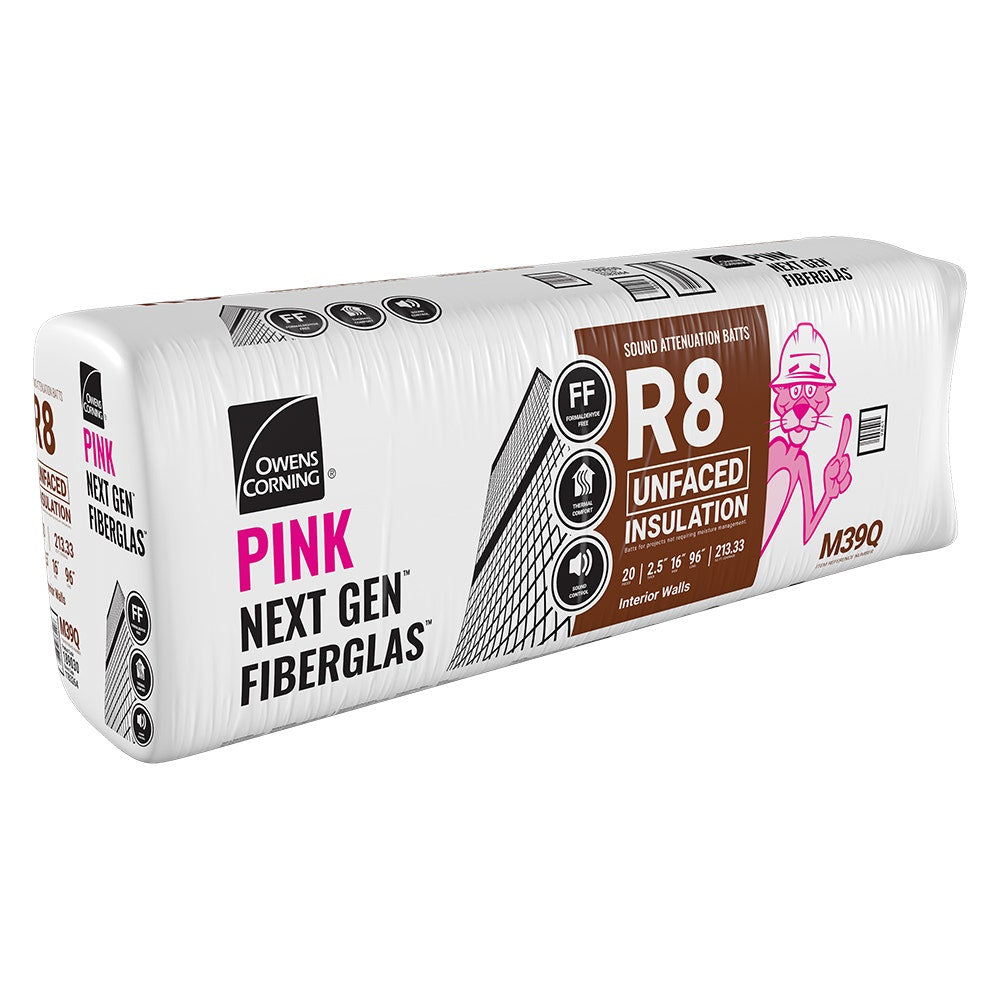
2.5 in. thickness for shallow interior wall cavities
Key features
16 in. width for 16 in. o.c. stud bays
PINK Next Gen handling with improved recovery and less dust
Technical specifications
| R-Value | 8.0 |
|---|---|
| Thickness | 2.5 in |
| Width | 16.0 in |
| Length | 96.0 in |
| Coverage | 213.0 sq ft/pack |
| Material | Fiberglass (PINK Next Gen), unfaced |
| Fire rating | ASTM C665; unfaced glass fibers classified noncombustible per ASTM E136 in manufacturer documentation. Unfaced PINK Next Gen acceptable ICC types I–V per OC literature. |
| Sound rating | Intended for sound attenuation in interior walls; published STC requires full assembly testing—design with flanking and penetration details in mind. |
| Density | See manufacturer TDS for nominal density and ASTM C665 type language for this SKU. |
| Thermal conductivity | Labeled R-8 at 2.5 in.; see manufacturer TDS (ASTM C518) for tested values. |
| Framing width | 16 in. width for 16 in. on-center stud spacing |
| Construction type | Wood-frame and light-gauge metal-frame cavity construction |
| Application area | Interior partitions, corridor walls, wood- and metal-framed cavities where thin R-8 unfaced batts are specified; not a substitute for high-R exterior walls unless code-approved. |
Product details
About 213 square feet per package (IDI-listed coverage for this SKU). Primary use: interior partition walls, demising walls, and other 16 in. on-center cavities where designers specify R-8-class unfaced fiberglass to improve sound transmission loss compared with an empty stud bay while keeping the cavity shallow.
The R-8 PINK Next Gen line is commonly categorized as sound-attenuation batts (SAB): 2.5 in. labeled thickness fits nominal 2×3 or furred channels and other tight spaces where thicker thermal batts simply will not fit, while the 16 in. width matches the 14-1/2 in. clear width for 16 in. o.c. wood framing. The 96 in. length supports typical eight-foot stud layouts with standard end cuts. Next Gen fiber technology emphasizes softer feel, improved recovery after compression packaging, and less nuisance dust on the jobsite than legacy fiberglass generations.
Treat these batts as part of an overall acoustic spec: seal perimeter gaps, use putty pads or acoustical sealant at outlets when the STC assembly requires it, and remember that STC is system-dependent—insulation alone does not fix flanking paths through structure or ceilings. Thermally, R-8 is a modest resistor; do not substitute M39 where the energy code demands higher cavity R-values unless the authority having jurisdiction accepts a documented assembly.
Manufacturing is to ASTM C665; unfaced glass fiber is classified noncombustible per ASTM E136 in manufacturer documentation, with unfaced PINK Next Gen listed for ICC construction types I through V when installed per OC guidance. GREENGUARD certification with formaldehyde-free validation and a UL Environment EPD match the rest of the PINK Next Gen family. Download the linked data sheet for authoritative coverage, weights, and compliance statements.
Interior acoustic specs are won or lost on perimeter seals, outlet treatments, and flanking paths through slab and ceiling plenums—R-8 SAB thickness helps STC, but it is not a substitute for an engineered partition assembly.
Thermal note: R-8 cavity fill is a modest resistor; keep energy compliance separate from acoustic SKUs unless the jurisdiction explicitly allows this thickness in the exterior wall prescriptive table you are using.
Submittal discipline: keep the distributor-listed dimensions (2.5 in. × 16.0 in. × 96.0 in.) and about 213.0 square feet per package attached to the same SKU on purchase orders, delivery tickets, and photos for QA. Authoritative tested language and code-oriented statements belong in the current manufacturer technical data sheet at https://www.idi-insulation.com/media/pdfresources/1004270_data_sheet.pdf.
Documents & certifications
Technical data sheet
Manufacturer-tested R-value, coverage, fire notes, and handling—use for submittals, RFIs, and field QA.
Download PDF (opens in new tab)Certifications & compliance
GREENGUARD (formaldehyde-free validated), UL Environment EPD, California Title 24 Article 3 insulating materials
Frequently asked questions
Will M39 meet my STC requirement by itself?
Will M39 meet my STC requirement by itself?
STC is an assembly metric. Insulation helps, but you still need consistent perimeter sealing, correct gypsum layers, resilient channels or clips when specified, and treatment at outlets and penetrations. Reference tested assemblies rather than assuming a single batt solves every partition detail.
Can I use M39 in exterior 2x4 walls for code R-value?
Can I use M39 in exterior 2x4 walls for code R-value?
Only if your jurisdiction accepts R-8 cavity fill for that assembly—which is uncommon for above-grade exterior walls. Match cavity insulation to IECC prescriptive tables or performance models; M39 is primarily an interior acoustic and shallow-cavity tool.
Why is coverage so high per package?
Why is coverage so high per package?
Thin 2.5 in. batts pack more square feet per inch of thickness than deep R-30 or R-49 batts. Always verify the distributor’s stated square feet per package against the master-pack label before bidding.
Do I need a separate vapor retarder?
Do I need a separate vapor retarder?
Unfaced batts do not add a vapor retarder. Follow IECC and your designer’s hygrothermal plan for whether and where to install poly, smart membranes, or kraft on another component.