

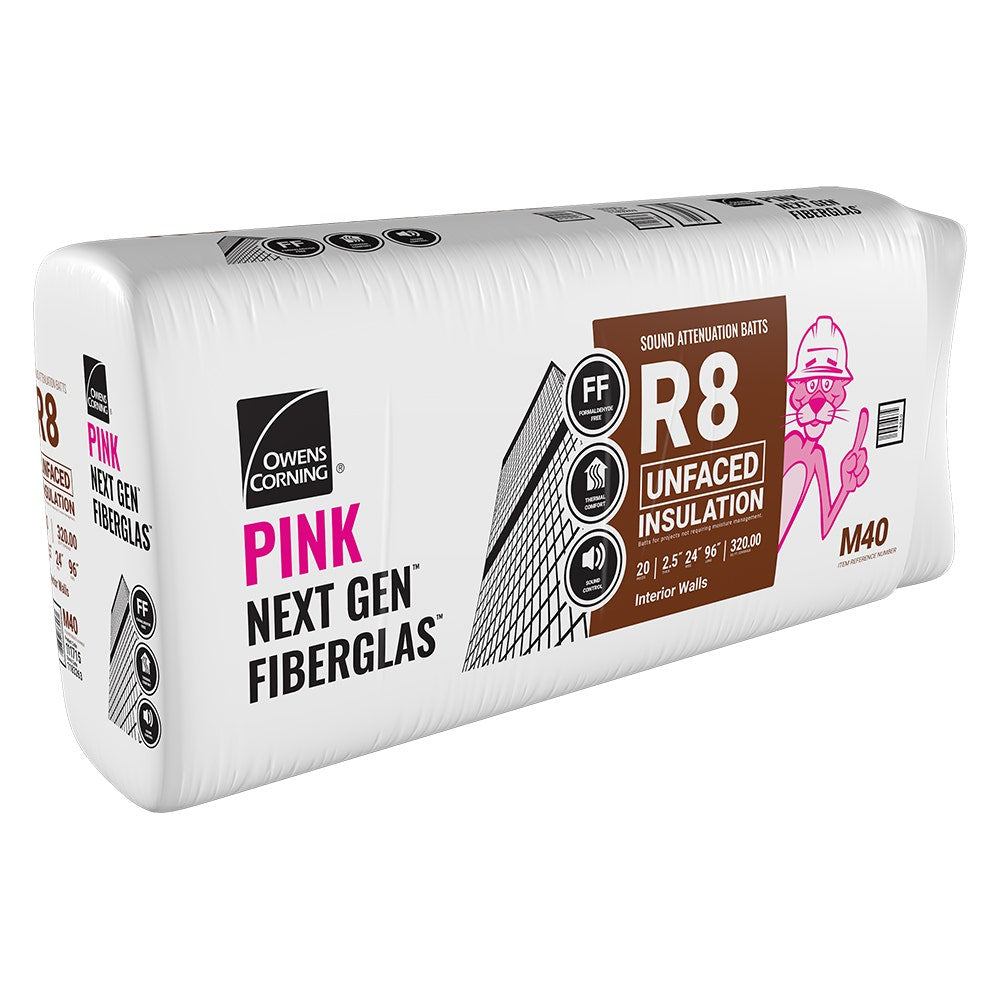
24 in. width for one-piece coverage in 24 in. o.c. bays
Key features
2.5 in. thickness for shallow interior wall cavities
Large 320 sq ft coverage per pack for long corridor runs
Technical specifications
| R-Value | 8.0 |
|---|---|
| Thickness | 2.5 in |
| Width | 24.0 in |
| Length | 96.0 in |
| Coverage | 320.0 sq ft/pack |
| Material | Fiberglass (PINK Next Gen), unfaced |
| Fire rating | ASTM C665; unfaced glass fibers classified noncombustible per ASTM E136 in manufacturer documentation. Unfaced PINK Next Gen acceptable ICC types I–V per OC literature. |
| Sound rating | Designed for sound attenuation in wide-module walls; assembly STC still depends on layers, seals, and penetrations. |
| Density | See manufacturer TDS for nominal density and ASTM C665 type language for this SKU. |
| Thermal conductivity | Labeled R-8 at 2.5 in.; see manufacturer TDS (ASTM C518) for tested values. |
| Framing width | 24 in. width for 24 in. on-center stud spacing |
| Construction type | Wood-frame and light-gauge metal-frame cavity construction |
| Application area | Interior partitions and commercial cavity walls on 24 in. centers where R-8 unfaced SAB is specified |
Product details
About 320 square feet per package (IDI-listed coverage). Primary use: 24 in. on-center interior or demising walls where the specification calls for R-8-class unfaced fiberglass and a single 24 in. wide batt is preferred to avoid a mid-bay joint that can become an acoustic leak.
M40 mirrors M39’s 2.5 in. labeled thickness and 96 in. length but increases width to 24 in. so one batt bridges the full clear span of a 24 in. module framing layout. That geometry is common in office remodels, warehouse partitions, and multifamily corridors where metal or wood studs sit on two-foot centers and the architect’s acoustic schedule still expects insulation in the cavity.
From a performance standpoint, think of this SKU as a sound-and modest-thermal layer, not a substitute for exterior-wall R-values. Seal perimeters, coordinate with gyp layers and resilient systems when the STC assembly demands them, and document flanking paths through slab, deck, and ceiling plenums because insulation cannot fix structure-borne sound by itself.
Manufacturing complies with ASTM C665; unfaced glass fiber is classified noncombustible per ASTM E136 in manufacturer documentation, and unfaced PINK Next Gen is listed for ICC construction types I through V when installed per OC guidance. GREENGUARD certification with formaldehyde-free validation and a UL Environment EPD align with typical tenant improvement submittals. Use the linked technical data sheet for package weights, coverage verification, and code references.
Wide-module interior corridors reward single-piece 24 in. batts because mid-bay joints can become acoustic leaks when gyp layers and sealant schedules are tight; still document penetrations and door head conditions where flanking dominates.
Staging high-coverage packs on multifloor jobs requires vertical lift planning; do not assume lightweight just because the batt is thin—total square feet per pack is high for R-8 SAB lines.
Submittal discipline: keep the distributor-listed dimensions (2.5 in. × 24.0 in. × 96.0 in.) and about 320.0 square feet per package attached to the same SKU on purchase orders, delivery tickets, and photos for QA. Authoritative tested language and code-oriented statements belong in the current manufacturer technical data sheet at https://www.idi-insulation.com/media/pdfresources/1004271_data_sheet.pdf.
Documents & certifications
Technical data sheet
Manufacturer-tested R-value, coverage, fire notes, and handling—use for submittals, RFIs, and field QA.
Download PDF (opens in new tab)Certifications & compliance
GREENGUARD (formaldehyde-free validated), UL Environment EPD, California Title 24 Article 3 insulating materials
Frequently asked questions
M39 versus M40—which do I order?
M39 versus M40—which do I order?
Match width to stud spacing. M39 is 16 in. wide for 16 in. on-center bays; M40 is 24 in. wide for 24 in. on-center bays. Both share 2.5 in. thickness and R-8 labeling but package coverage differs.
Can metal studs crush this thin batt?
Can metal studs crush this thin batt?
Install so the batt recovers to labeled thickness without folding dense wads at studs. If the metal channel is unusually tight, verify cavity depth and consider manufacturer guidance on compression limits.
Is R-8 enough for exterior walls?
Is R-8 enough for exterior walls?
Generally no for IECC-compliant exterior walls in modern codes. Use M40 where the specification calls for thin acoustic insulation in interior or specialty cavities, not as a blanket exterior-wall solution unless engineered and approved.
How should I store 320 sq ft packs?
How should I store 320 sq ft packs?
Keep bags dry, off soil, and slit bundles so batts recover before installation. Wet glass fiber or permanently crushed packs should not be buried in the wall.