

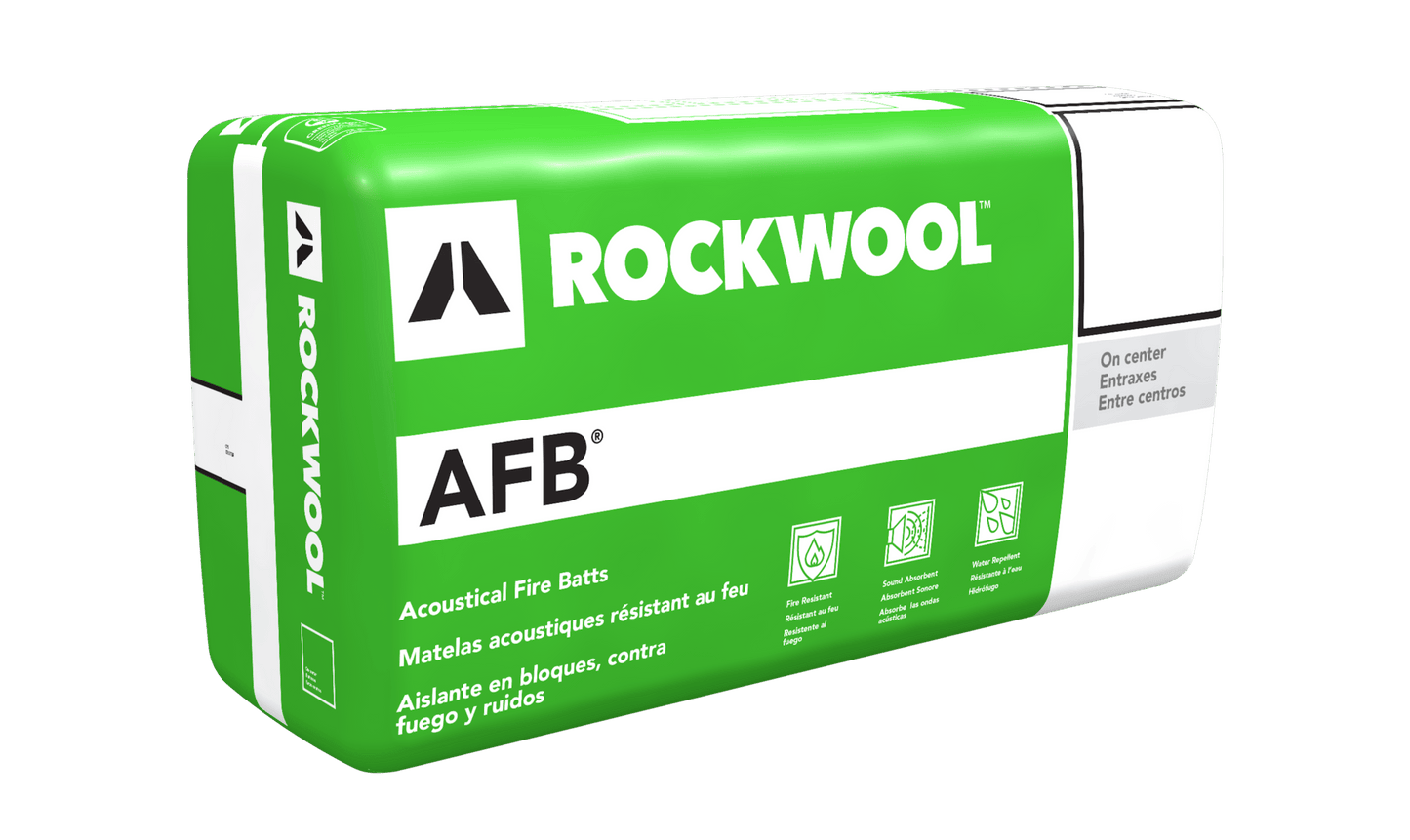
5 in. thick AFB for demanding interior acoustic partitions when stud depth allows
Key features
Noncombustible stone wool; 0/0 ASTM E84 indices per USA TDS
Use manufacturer data for absorption: TDS table spans 1–4 and 6 in. nominal thicknesses
Technical specifications
| Thickness | 5.0 in |
|---|---|
| Width | 16.0 in |
| Length | 48.0 in |
| Coverage | 42.67 sq ft/pack |
| Material | Stone wool (mineral wool), ROCKWOOL AFB® |
| Fire rating | Noncombustible per ASTM E136; Flame Spread 0 / Smoke Developed 0 per ASTM E84 on ROCKWOOL USA AFB TDS; rated assemblies must be listed designs. |
| Sound rating | ROCKWOOL USA AFB TDS publishes NRC/SAA for 4 in. (NRC 1.10 / SAA 1.11) and 6 in. (NRC 1.15 / SAA 1.14) but not 5 in.; request 5 in. documentation from ROCKWOOL for strict submittals. |
| Density | Nominal density >2.5 lb/ft³ per ASTM C167 on ROCKWOOL USA AFB TDS; manufacturer notes actual density varies with thickness. |
| Framing width | 16 in. batt width for 16 in. steel-stud bays requiring thick cavity fill |
| Construction type | Interior steel-stud module (16 in. × 48 in. format; verify actual stud depth for 5 in. insulation thickness) |
| Application area | High-performance interior partitions and floor/ceiling cavities where 5 in. stone wool AFB matches the specifier’s tested assembly and stud depth. |
Product details
Five inches of stone wool is not an everyday partition detail, but it appears when STC contracts, music rooms, boardrooms, or specialty healthcare and education programs push wall thickness while staying in steel framing. AFB’s role is to deliver dense, noncombustible cavity media that installers can still seat without turning the stud bay into a voided mess.
The ROCKWOOL USA AFB data sheet (11-2025) is explicit about which acoustical rows it publishes: third-octave absorption, NRC, and SAA appear for 1, 2, 3, 4, and 6 in. nominal thicknesses. There is no printed 5 in. row in that table, so YEARS will not invent an NRC here. Engineers should interpolate cautiously—absorption generally rises with thickness in fibrous media—or request a written submittal from ROCKWOOL Technical Services for project-specific documentation.
Fire performance remains anchored to the same family claims: noncombustible per ASTM E136 / CAN/ULC S114 statements and 0/0 flame spread and smoke developed per ASTM E84 on the sheet. Hourly ratings still require UL/Intertek listed assemblies that include the correct stud depth, gypsum type, and insulation thickness.
Logistics matter at 5 in.: packages are heavier, corridors tighter, and coordination with door frames and head-of-wall joints more sensitive. Plan lifts, verify deflection, and keep the air barrier continuous at joints and penetrations.
Some distributors quote approximate thermal resistance values for thick AFB in marketing copy; the USA AFB PDF emphasizes acoustics, fire reaction, and blanket insulation standards rather than publishing an R-value chart like thermal batts. If your energy model needs an R-value, obtain it from the manufacturer or use a calculation acceptable to the AHJ rather than assuming a blog figure.
Start every submittal with https://p-cdn.rockwool.com/syssiteassets/o2-rockwool/documentation/technical-data-sheets/commercial/afb-acoustical-fire-batts-techdata.pdf and the AFB landing page at https://p-cdn.rockwool.com/north-america/products-and-applications/products/afb so certifications match the issuance date.
Documents & certifications
Technical data sheet
Manufacturer-tested R-value, coverage, fire notes, and handling—use for submittals, RFIs, and field QA.
Download PDF (opens in new tab)Certifications & compliance
ASTM C665 Type I, ASTM C553 Type VII, CAN/ULC S702 Type I, ASTM E136 noncombustible, ASTM E84 flame spread 0 / smoke developed 0 (Class A per IBC Note 1 on TDS), UL GREENGUARD Gold and USDA BioPreferred 25% biobased per ROCKWOOL AFB product page
Frequently asked questions
What NRC applies to the 5 in. AFB batt?
What NRC applies to the 5 in. AFB batt?
The ROCKWOOL USA AFB data sheet dated 11-2025 does not list a dedicated 5 in. row in its NRC/SAA table; it publishes values for 1, 2, 3, 4, and 6 in. nominal thicknesses. For contractual acoustic calculations on 5 in. product, contact ROCKWOOL Technical Services with your assembly details.
Why is coverage only about 42.67 sq ft?
Why is coverage only about 42.67 sq ft?
Thicker batts pack fewer square feet per bundle than 2 in. or 3 in. SKUs. Always confirm square footage and piece count on the master-pack label before ordering.
Can I use this SKU in a 3-5/8 in. metal stud?
Can I use this SKU in a 3-5/8 in. metal stud?
A 5 in. batt requires a cavity depth that accepts full thickness without chronic compression. Verify stud depth, deflection, and interior finish tolerances; compressed insulation under-performs acoustically and thermally.
Is AFB a replacement for fire caulk at penetrations?
Is AFB a replacement for fire caulk at penetrations?
No. Maintain penetration firestop systems per the tested design. AFB fills stud bays; it does not replace rated sealants, devices, or joint systems at MEP penetrations.